Whether the Exotic Shorthair Used the American Shorthair
If you have heard that the Exotic Shorthair is a shorthaired Persian, you may also wonder where the American Shorthair fits into its story. It did play a part: breeders used American Shorthairs in early Exotic development, but that does not mean every Exotic today is a recent American Shorthair cross. Here’s how the breeds are connected—and where their histories diverge.
How the American Shorthair helped create the Exotic Shorthair
The early goal was a Persian look with a short coat
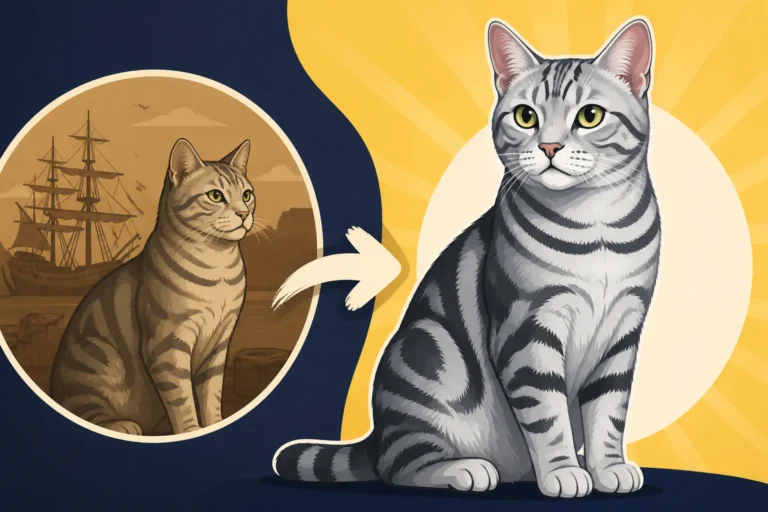
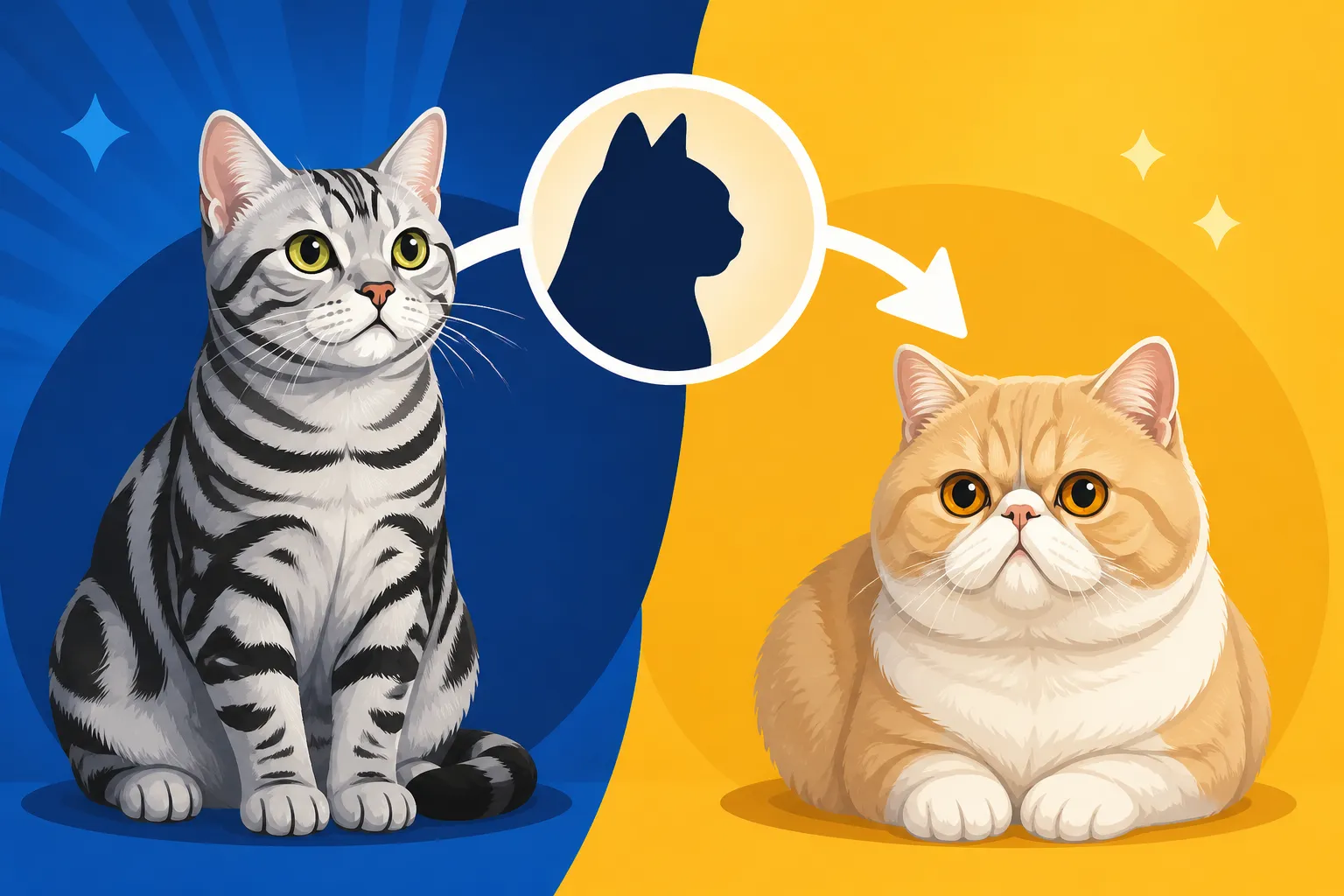
The Exotic Shorthair took shape in the United States in the mid-20th century. Breeders wanted cats with the Persian’s rounded head, substantial body, and gentle expression, but with a short, dense coat that required less grooming. The American Shorthair was among the breeds used in early crosses to help explore that combination.
The American Shorthair’s role was not simply to supply a short coat. Early crosses also reflected efforts to introduce or improve particular colors and patterns in cats being bred toward the emerging Exotic type. Breeders then selected cats that retained the Persian-like shape and appearance while carrying a short coat. The result was a distinct breeding program, rather than a permanent blend of two breeds in equal measure.
This history is part of the broader story of how deliberate crosses shaped cat breeds. The American Shorthair itself has a complicated history of outcrossing and selection; Which Breeds the American Shorthair Was Outcrossed To gives more context on that side of the story. And the Exotic’s development is one example of the larger question of Which Breeds Came From the American Shorthair.
The Exotic became its own breed
As breeders selected for a consistent Persian-like appearance and a short coat, the developing cats became recognizable as a separate breed. The Exotic Shorthair received recognition as a breed in the 1960s. From there, its identity depended on an increasingly defined standard and breeding program—not simply on whether one of its ancestors had been an American Shorthair.
That distinction matters. An early foundation cross can leave a lasting mark on a breed’s history without being repeated in every later generation. Think of a family recipe that was adapted long ago: an ingredient may have helped shape the original, even though today’s version is made according to a settled formula. In the Exotic’s case, its Persian-like structure and short coat became the defining combination.
For a closer look at the physical traits breeders select for in the American Shorthair, see What the American Shorthair Standard Asks For. The comparison helps explain why “used in the early development” is not the same as “looks just like an American Shorthair” or “is currently bred as an American Shorthair cross.”
What the two breeds share—and what sets them apart
A shared chapter does not make them the same breed
Both breeds can have short coats and rounded, substantial bodies, so photographs may occasionally make them seem more alike than they are. But a short coat alone does not identify a cat as an American Shorthair or an Exotic Shorthair. Their overall type, head shape, coat texture, and breeding history all matter.
An American Shorthair is generally bred to a balanced, working-cat type, with a sturdy frame and a face that is not as extremely shortened as a Persian-type face. The Exotic Shorthair is bred to retain the Persian’s characteristic head and overall look while having a short, plush coat. Individual cats vary, but the breed standards describe different goals.
| Feature | American Shorthair | Exotic Shorthair |
|---|---|---|
| Historical role | North American working-cat type later developed as a pedigreed breed | Developed to combine a Persian-like appearance with a short coat |
| Early relationship | Used in the Exotic’s early development | Includes American Shorthair ancestry in its early breed history |
| Typical breeding direction | Balanced, sturdy type | Persian-like type with a dense, short coat |
| Coat | Short, dense coat with breed-approved colors and patterns | Short, plush coat associated with its Persian-like type |
| What establishes pedigree | Registry records and documented lineage | Registry records and documented lineage |
For a more detailed side-by-side look, read How an American Shorthair Differs From an Exotic Shorthair. The most useful takeaway is that coat length is only one feature. A cat does not become an Exotic simply because it has a round face and short fur, and an Exotic does not become an American Shorthair because American Shorthairs appear in its early history.
Similar appearance is not proof of ancestry
A cat’s appearance can suggest a breed type, but it cannot reliably reconstruct its family tree. Many domestic cats have short coats, tabby markings, or sturdy bodies. Those traits are not exclusive to the American Shorthair, and a resemblance to an Exotic does not establish that a cat has Exotic ancestry.
If you are choosing a pedigreed cat, the practical evidence is documentation from the breeder and the relevant registry. A pedigree records named ancestors; it does not mean that every cat in the family tree belongs to the same breed or that an old foundation cross is still happening. For more on what paperwork can and cannot tell you, see What an American Shorthair Pedigree Guarantees.
DNA tests may offer information about genetic ancestry, but they should not be treated as a substitute for registration papers or a complete, documented pedigree. A visual assessment or a commercial test cannot by itself confirm that a cat is a registered American Shorthair or Exotic Shorthair. Whether a DNA Test Tells an American Shorthair From a Moggy explains why breed identification is not as straightforward as matching a cat to a photo.
Is the American Shorthair still used to breed Exotics?
Early outcrosses and modern breeding are different questions
The answer depends on what you mean by “used.” Historically, yes: American Shorthairs were among the breeds used while breeders were developing the Exotic Shorthair. That is a meaningful part of the breed’s origin.
But historical use does not automatically mean that breeders are still crossing the two breeds today. Once a breed has an established type, its breeding rules may change. Registries can also differ in their rules, and those rules may be revised. If you are looking at a particular cat or breeding program, ask the breeder which registry governs the litter and what outcrosses are currently permitted under that registry’s rules.
The American Shorthair has its own rules around breeding and ancestry, too. Whether Outcrossing Is Still Allowed in the American Shorthair looks at that question from the American Shorthair’s perspective. The key point is to avoid treating all historical crossbreeding as if it were still standard practice.
Ask for the specific record, not a vague claim
A breeder saying “this breed came from that breed” may be describing a distant historical influence, not the parents or grandparents of a particular kitten. If recent ancestry matters to you, ask for the kitten’s pedigree and clarification about any recorded outcrosses. A responsible breeder should be able to explain the lineage in plain language and identify the registry’s rules for the litter.
It is also fair to ask what the breeder means by “American Shorthair blood.” Do they mean the documented foundation history of the Exotic breed, or a recent American Shorthair ancestor in this kitten’s pedigree? Those are very different claims. Written records help keep the conversation clear and let you compare what you are being told with the actual family tree.
If you are considering an American Shorthair rather than an Exotic, the same habit is useful: look for records that support the specific breed claim, and do not rely on coat color or a seller’s description alone. A pet-supply retailer such as Chewy can help with routine items after you bring a cat home, but a shopping listing is not pedigree documentation. Chewy is useful for supplies, not for confirming breed ancestry.
What this connection means for prospective owners
Choose by the cat in front of you, not just its origin story
The Exotic’s American Shorthair connection is interesting, but it is only one part of its history. If you are choosing between an Exotic and an American Shorthair, focus on the adult characteristics and care expectations that matter in your home. Both are shorthaired, but the Exotic’s coat is plush and dense, and its Persian-like facial structure can bring different care considerations than the more moderate American Shorthair type.
Ask about the parents’ health, temperament, and routine care. Spend time with the cats if possible, and ask how the breeder raises kittens and prepares them for household life. A breed’s history can help you understand how it developed; it cannot guarantee the temperament or health of an individual kitten.
For an adopted cat whose background is unknown, it is usually most helpful to describe what you can observe: coat, body shape, activity level, and health needs. You do not need to settle the ancestry question before giving a cat good care. If you are preparing for a new cat, Chewy can be one place to find practical supplies such as a suitable carrier or scratching surface. Those purchases support everyday care, not breed verification.
Keep the history in perspective
The American Shorthair did contribute to early Exotic Shorthair development. That is the direct answer. The Exotic later became a breed with its own recognizable type and breeding history, so its present-day identity is not simply “an American Shorthair with a different coat.” The connection is real, but it belongs to the breed’s development rather than serving as a shortcut for identifying an individual cat.
When researching a kitten, separate three questions: which breeds helped establish the breed historically, what the registry allows in current breeding, and what the specific kitten’s documented pedigree shows. Keeping those questions apart prevents a common mix-up between a breed’s distant origins and a cat’s immediate ancestry. If you need everyday feeding, litter, or grooming basics once your cat is home, Chewy may be a convenient place to browse those essentials; for pedigree questions, rely on breeder records and the relevant registry.
Disclaimer
This article is for general informational purposes only and does not constitute professional advice. Laws, prices and regulations vary by location and change over time. Consult a qualified professional for guidance on your specific situation.