How the American Wirehair Came From the American Shorthair
The American Wirehair did not begin as a carefully planned cross between two established breeds. Its story starts with a naturally occurring coat mutation in a litter of farm cats in New York, then continues through deliberate breeding that included American Shorthairs. Understanding that distinction helps explain why the two breeds look related, yet are registered and recognized separately.
The American Wirehair’s story began with a kitten
A spontaneous coat mutation in upstate New York
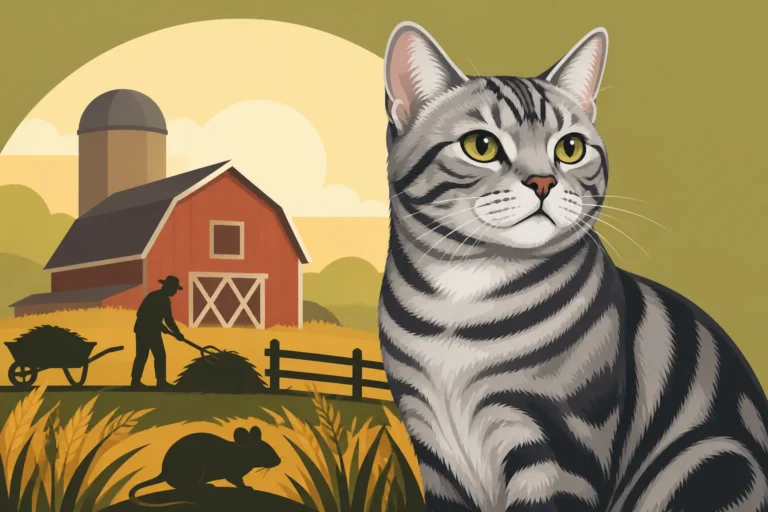
The American Wirehair’s recorded history starts in 1966, when a kitten with an unusually crimped coat appeared in a litter of barn cats in Verona, New York. The other kittens had ordinary straight coats. This one stood out for the wiry texture of its fur, a trait that had not been deliberately bred into the litter.
A local breeder, Joan O’Shea, acquired the kitten and named him Council Rock Farm Adam of Hi-Fi. Adam is generally identified as the foundation cat of the American Wirehair breed. His distinctive coat was not the result of a planned pairing between an American Shorthair and a wire-coated breed. It appeared spontaneously in cats whose broader ancestry was not documented as a modern pedigree.
That detail matters because it is easy to hear that American Wirehairs were developed with American Shorthairs and assume the first wirehaired kitten was a direct American Shorthair cross. The more careful version is that the first known wirehaired cat emerged in a farm-cat litter, and breeders later used American Shorthairs to help develop the breed.
The circumstances make sense in the context of farm cats, which were valued for practical qualities rather than carefully recorded family trees. The ancestors of the American Shorthair also came from working cats, a history explored in How Farm Work Shaped the American Shorthair. But a shared working-cat background is not the same thing as proof that Adam himself had a documented American Shorthair pedigree.
How breeders established that the coat could be inherited
Adam was bred to a straight-coated cat, and some kittens in the resulting litter had wire-textured coats. That was an important clue: the coat was not simply a temporary quirk or an effect of age. It could be passed from parent to kitten.
The wirehair trait is understood to be dominant. In simple terms, a cat can inherit the trait from one parent and show the characteristic coat; it does not need to receive a matching copy from both parents. This differs from the inheritance pattern associated with the coats of some other curly- or wavy-coated cat breeds. The visible result is also distinct: American Wirehair hairs are kinked or bent, creating a springy, coarse feel rather than the more uniform curl associated with some rex coats.
Breeders had to learn how reliably the trait appeared in different pairings, while also paying attention to overall health, body type, temperament, and coat quality. A distinctive coat alone does not make a stable breed. The aim was to establish cats that consistently carried the wirehair trait while remaining sound, recognizable, and suitable as companions.
How American Shorthairs helped develop the breed
A planned breeding role, not the original mutation
Once breeders began developing American Wirehairs, American Shorthairs became an important part of the story. They were used in breeding programs to support the new breed’s development, helping maintain a familiar, sturdy type and contributing to the population from which later Wirehairs were bred.
That is why the American Wirehair is often described as having come from the American Shorthair. It is a useful shorthand for the relationship, but it leaves out the key first step: the original wirehaired kitten was a spontaneous mutation in a farm-cat litter, not the planned product of a standard American Shorthair mating. American Shorthairs helped shape and support the breed after that discovery.
The process is similar to how a new trait can appear within a broader cat population and then be selectively developed. Breeders identify the unusual feature, test whether it is inherited, and make careful pairings to preserve it without losing desirable qualities. In this case, American Shorthair ancestry was part of the development, while the wirehair mutation gave the emerging breed its defining feature.
For background on how American Shorthair breeding has involved other cats, see Which Breeds the American Shorthair Was Outcrossed To. The history of the American Wirehair is related to that broader topic, but the two breed histories should not be collapsed into one: the Wirehair’s own defining mutation arose independently.
Shared appearance does not make them the same breed
American Wirehairs and American Shorthairs can look quite similar at first glance. Both are medium-to-large cats with solid, muscular bodies, rounded features, and a practical, balanced appearance rather than an extreme silhouette. Their histories and development are connected, so the resemblance is not surprising.
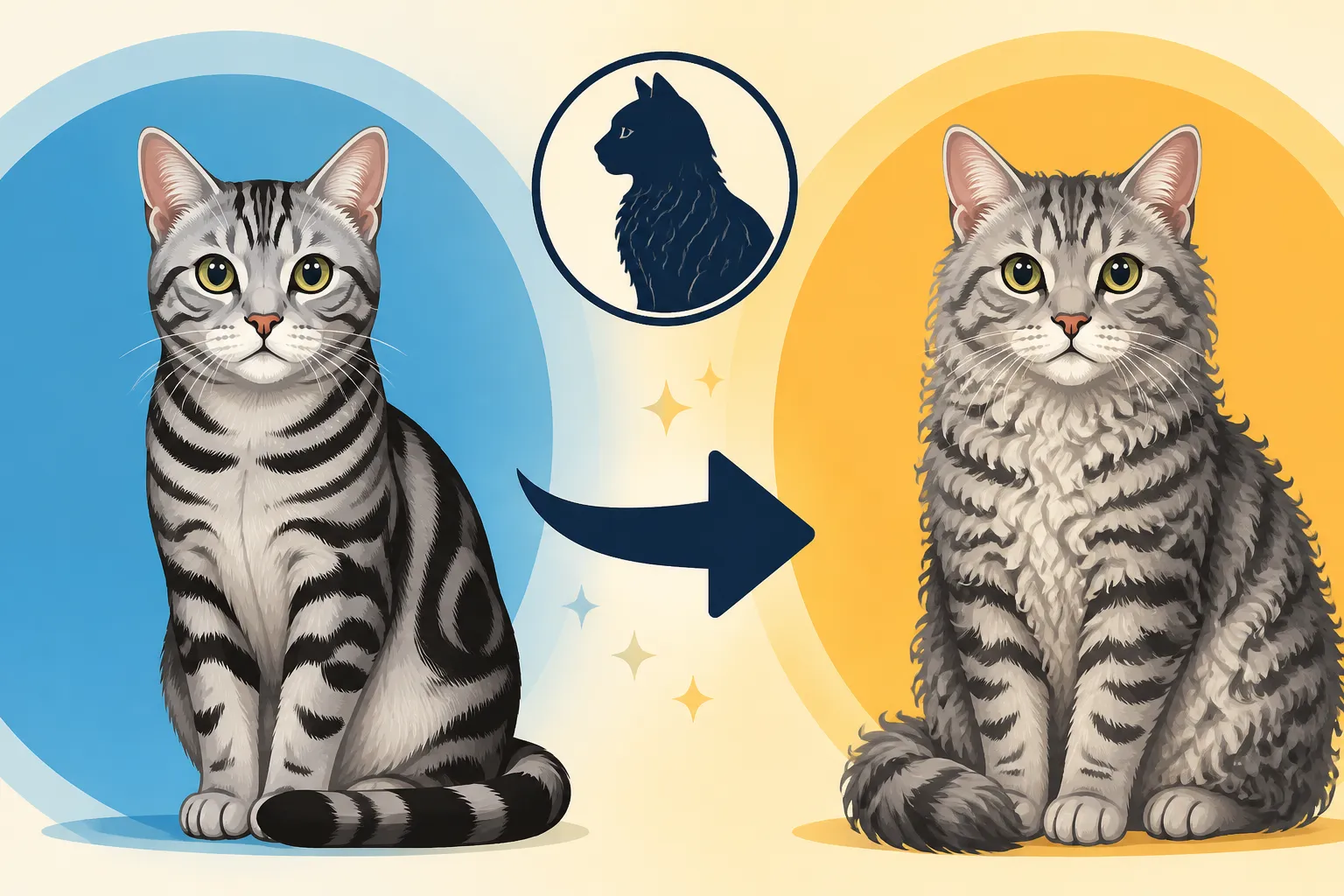
The coat is the clearest difference. An American Shorthair has a dense, short coat with a more conventional texture. An American Wirehair’s coat has a springy, crimped quality, and individual hairs may bend or hook. Whiskers can also be wavy or irregular. The degree of texture can vary, so a photograph may not always show the difference as clearly as touch does.
They are recognized as separate breeds, with their own standards and pedigrees. A cat that looks like an American Shorthair but has a rough or unusual coat is not automatically an American Wirehair. Breed identity depends on documented ancestry and registration, not appearance alone. For a closer visual comparison, see What an American Wirehair Is Next to an American Shorthair and What an American Shorthair Looks Like by the Standard.
| Feature | American Wirehair | American Shorthair |
|---|---|---|
| Breed origin | Developed from a spontaneous wirehair mutation found in a farm-cat litter | Developed from working cats and later established as a pedigree breed |
| Defining coat feature | Kinked, crimped, springy texture | Dense, short coat with a more conventional texture |
| Relationship | American Shorthairs were used in the breed’s development | Contributed to the development of American Wirehairs |
| Breed status | A distinct breed with its own standard and pedigree | A separate breed with its own standard and pedigree |
From a farm kitten to a recognized breed
The difference between a coat mutation and a breed
A single kitten with a striking coat is a discovery, not yet a breed. To establish a breed, breeders need to show that the trait can be passed on and create a population with consistent, recognizable characteristics. That takes time, recordkeeping, and repeated decisions about which cats should be paired.
In the American Wirehair’s case, the wirehair coat provided the defining feature, while American Shorthair breeding helped support the developing population. The aim was not simply to create cats with unusual fur. Breeders also needed to maintain a healthy body structure and a coherent type, rather than allowing the coat to become the only selection priority.
This is one reason the breed’s origin is sometimes simplified in casual descriptions. “American Wirehairs came from American Shorthairs” captures part of the development, but it can make the history sound more direct than it was. A more complete explanation is that the breed began with a spontaneous mutation in farm cats and was subsequently developed with American Shorthairs among its breeding partners.
The American Shorthair’s own identity also took shape over time as breeders distinguished pedigree cats from the much larger population of domestic shorthairs. Those distinctions are discussed in How an American Shorthair Differs From a Domestic Shorthair. The same general lesson applies here: resemblance and shared ancestry can tell part of a story, but they do not replace documented breed history.
Outcrossing and the importance of careful records
Outcrossing means pairing a cat with one from another breed or population, rather than restricting every pairing to cats already within the same breed. During the development of a small or newly established population, outcrossing can help breeders work with a broader base of cats. It is not a casual shortcut: the goals, allowed pairings, and registration rules depend on the breed and governing registry.
American Shorthairs were used as outcrosses in the development of the American Wirehair. That historical practice does not mean any American Shorthair and any cat with a wiry coat will produce a registered American Wirehair. Breed programs have rules, and pedigree records matter. The rules can also differ between registries and may change, so anyone considering breeding should check the relevant registry’s current requirements rather than rely on an old summary.
The history is a useful example of how a breed can arise through a combination of chance and intentional selection. Chance produced the unusual coat in the first known kitten. Breeders then had to make deliberate choices about preserving that coat, establishing a recognizable type, and maintaining a sustainable breeding population. For a related look at the role of outcrossing in breed development, see Whether Outcrossing Is Still Allowed in the American Shorthair.
What the American Wirehair’s origin means for owners
Coat care is about texture, not just length
The Wirehair’s coat may look low-maintenance because it is short, but its unusual texture deserves gentle handling. Individual coats vary: some are more strongly crimped than others, and the coat can feel different across the body. A routine that works for a straight-coated cat may not suit every Wirehair.
Start with occasional, gentle checks for loose hair, tangles, or skin irritation. Avoid assuming that frequent vigorous brushing will improve the coat; rough handling may disrupt its texture. If the cat has a skin or coat concern, or seems uncomfortable during grooming, ask a veterinarian for advice rather than experimenting with products or tools.
For ordinary supplies, a soft brush or grooming tool selected for the cat’s coat can be easier to manage than a one-size-fits-all kit. Retailers such as Chewy may offer a range of brushes and combs, but the tool should suit the individual cat, and grooming should remain calm and brief. If your Wirehair resists, stop and try again later rather than turning coat care into a wrestling match.
Choose a cat by history and fit, not a label alone
If you are looking for an American Wirehair, ask about pedigree documentation, health history, and how the breeder describes the coat and temperament. A trustworthy breeder should be comfortable explaining the cat’s lineage and answering questions about the breed’s development. Be wary of anyone who treats a wiry-looking coat as sufficient proof of pedigree.
If you are considering an American Shorthair instead, remember that its connection to the Wirehair’s development does not mean the breeds are interchangeable. Their coats, standards, and registered histories differ. Reading about Whether a Domestic Shorthair and an American Shorthair Differ Genetically can also help clarify why a cat’s appearance alone does not establish its breed.
For an adopted cat with an unknown background, the most useful questions are practical: Is the cat comfortable being handled? Does its coat need special attention? Has a veterinarian examined its skin and general health? A cat does not need a pedigree to be a wonderful companion. The important thing is to understand the animal in front of you, rather than relying on a breed label that its history cannot support.
If you are comparing grooming supplies, Chewy can be one place to browse brushes, combs, and basic care items; check that any product is appropriate for your cat’s coat and skin. A simple, gentle routine is usually more useful than buying a collection of tools before you know what your particular cat tolerates. A reputable veterinarian can help if the coat becomes patchy, irritated, or unusually difficult to manage.
Disclaimer
This article is for general informational purposes only and does not constitute professional advice. Laws, prices and regulations vary by location and change over time. Consult a qualified professional for guidance on your specific situation.