Which Breeds the American Shorthair Was Outcrossed To
Tracing the American Shorthair’s outcrosses is harder than finding a neat list of breeds: its story includes old working cats, developing show standards, and deliberate breeding decisions that changed over time. This guide explains which breeds are most often associated with those crossings, why breeders used them, and what that history does—and does not—tell you about a cat today.
Why the American Shorthair Was Outcrossed
A working cat became a standardized breed
The cats behind the American Shorthair were not originally a carefully managed pedigree breed. They were practical, shorthaired cats valued for hunting rodents around farms, homes, and ships. Their ancestry developed over generations, rather than through a single planned pairing of named breeds. The popular story of cats arriving on early ships captures part of that history, but it does not mean every ancestor can be traced to a particular vessel or breed. For more on that distinction, see The Mayflower Cats Behind the American Shorthair and Ships Carried the American Shorthair's Ancestors as Ratters.
Once cat fanciers began registering and showing these cats, breeders had a new challenge: preserve a useful, sturdy animal while establishing a recognizable, consistent type. Early American Shorthairs varied in appearance because the population came from a broad mix of ordinary domestic cats. A breeder might find a cat with a desirable coat or build, but that did not guarantee the same qualities would reliably appear in its kittens.
Outcrossing—mating a cat from one breed with a cat from another—could introduce a particular trait or widen the breeding population. It was one tool breeders could use while developing the American Shorthair, not a single recipe that created the breed overnight. The history is easier to understand alongside What the Breed Was Called Before American Shorthair and Why the American Shorthair Name Changed in 1966.
Outcrossing did not mean the breed had no identity
The word “outcross” can sound as if American Shorthairs were simply mixed cats with a new label. That misses the difference between a historical breeding practice and the identity of an established breed. A breed can have a documented history of crossing with other breeds and still develop a distinct standard, population, and recognizable set of traits over time.
It also matters when the crossing occurred and what a writer means by “outcrossed.” Some accounts describe direct, intentional matings; others discuss a breed’s broader ancestry or the influence of related cats. These are not interchangeable claims. A historical connection between two breeds does not automatically prove that one was routinely used as an approved outcross to the other.
That distinction is especially important when comparing the American Shorthair with the British Shorthair. Their histories are connected, but shared ancestry and deliberate outcrossing are different things. Whether the British Shorthair Shares the American Shorthair's Ancestors explores that relationship in more detail.
Breeds Most Often Linked to American Shorthair Outcrossing
British Shorthair
The British Shorthair is commonly mentioned in discussions of the American Shorthair’s early development. Cats from Britain and continental Europe contributed to the wider pool of shorthaired domestic cats that became part of the American population. Later, as breeders selected for a formal show type, British Shorthairs may also appear in accounts of deliberate crossing or influence.
The caution is that “British influence” can refer to more than one thing. It may mean that related cats were present in the American Shorthair’s early ancestry; it may refer to intentional breeding to refine type; or it may be used loosely to describe similar physical features. A broad head or dense coat alone cannot establish that a particular cat was an outcross.
This is why the two breeds should not be treated as interchangeable. They have separate standards and breeding histories, even where their backgrounds overlap. For a visual and historical comparison, see How an American Shorthair Differs From a British Shorthair.
Persian
Persians are also frequently named in accounts of historical American Shorthair breeding. In general, breeders may use an outcross to add or strengthen a feature, broaden available lines, or address a limited breeding pool. But the precise purpose and extent of Persian influence can vary between descriptions, and it is not helpful to assume every Persian-associated cross was made for the same reason.
A Persian is a longhaired breed with a different overall look from the shorthaired American Shorthair. If a Persian was used in a particular historical line, that does not mean the American Shorthair as a whole became a Persian cross, nor does it establish that modern American Shorthairs should have Persian features. The breed’s identity comes from sustained selection and standards, not from one ancestor or one mating.
It is also easy to confuse this history with the American Shorthair’s later role in the development of other breeds. A breed can contribute to another breed’s foundation without that relationship being evidence of a reverse outcross into the American Shorthair. When reading a claim, check whether it says which breed was crossed into which, and during what period.
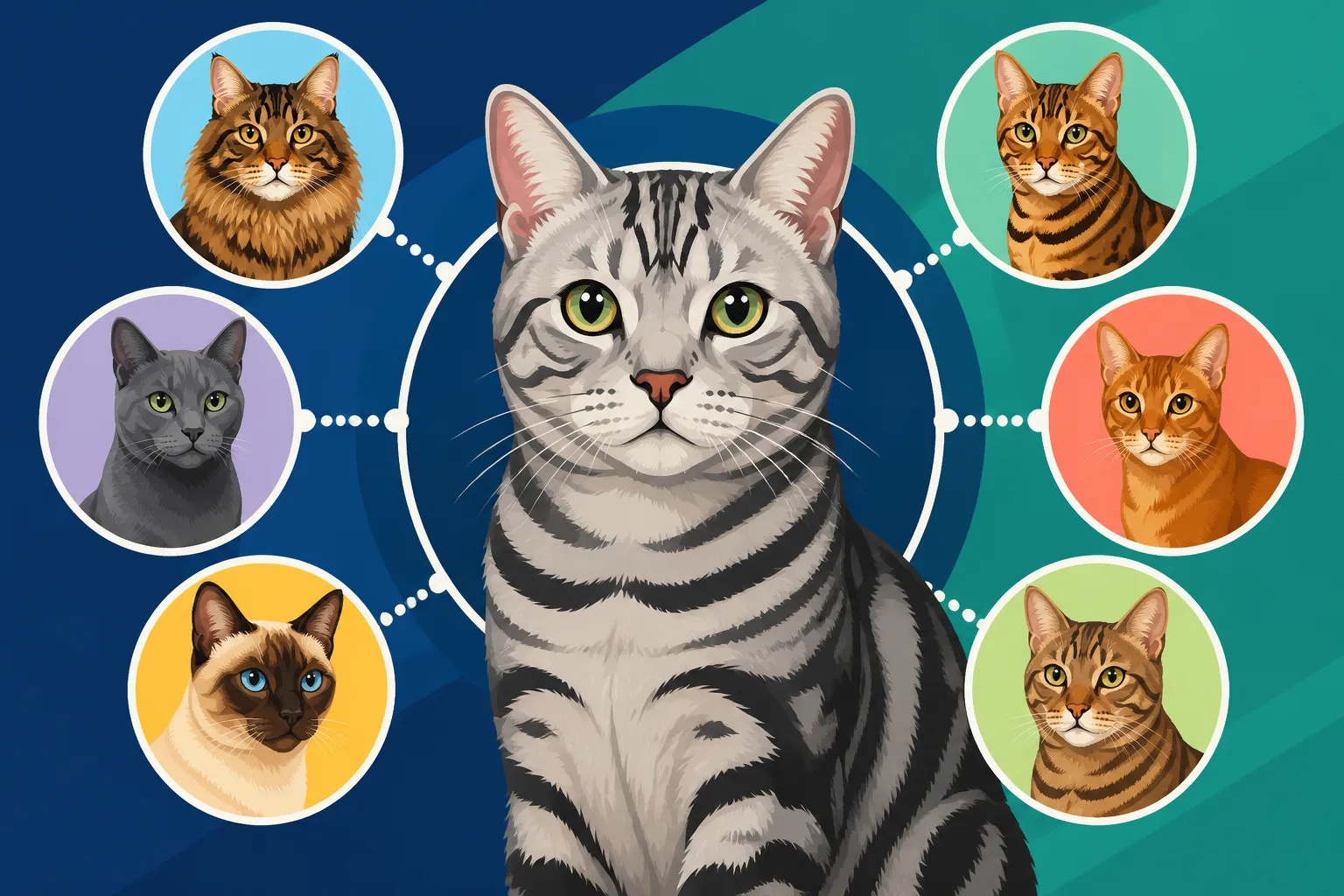
Burmese and Russian Blue
Burmese and Russian Blue cats are sometimes included in descriptions of historical outcrosses or influences. As with the British Shorthair and Persian, those mentions should be read with care. The available summaries do not always separate documented, intentional matings from broader claims about ancestry or influence, and not every breed named in a historical account necessarily played an equally large role.
A useful way to read these claims is to ask three questions: Was the breed used in a planned pairing, was it part of a broader historical population, or is the writer describing a resemblance? Without that distinction, a list of breed names can make the American Shorthair’s development sound more uniform and precisely documented than it was.
Some accounts also name Siamese cats. That does not mean Siamese influence defined the American Shorthair, or that a cat with a particular color or body shape must have Siamese ancestry. Breed history is about populations and breeding choices over time; appearance alone is not a reliable family tree.
| Breed mentioned in historical discussions | What the claim may refer to | What not to assume |
|---|---|---|
| British Shorthair | Shared background, related shorthaired stock, or deliberate breeding influence | That the two breeds are the same or that every similarity proves a recent cross |
| Persian | A reported historical outcross or influence in some breeding accounts | That Persian ancestry defines the modern American Shorthair |
| Burmese | A breed named in some accounts of historical crossings or influences | That it played the same role in every line or period |
| Russian Blue | A breed sometimes cited among possible historical influences | That a blue coat proves Russian Blue ancestry |
| Siamese | A breed occasionally included in broader accounts | That a color pattern or body feature establishes Siamese parentage |
The table is a guide to how these names are discussed, not a ranking of how much each breed contributed. Historical records and summaries may use “outcross,” “influence,” and “ancestry” differently.
How to Interpret Outcross Claims
Distinguish a documented mating from a general influence
A strong historical claim should identify more than a breed name. Ideally, it explains the period, the breeding purpose, and whether it refers to a specific mating or to a population-level influence. If an article says only that the American Shorthair “has Persian in it,” for example, that wording leaves too much unclear to draw a meaningful conclusion about a particular cat.
This is not just a historical nitpick. A family tree is built from records across generations, while a breed’s general history describes a larger population. One registered cat’s pedigree may show a connection that is not representative of the whole breed. Conversely, a breed may have historical influences that do not appear in every current pedigree.
For a broader discussion of how breeding choices and population breadth relate to the breed’s health, read How Wide the American Shorthair's Gene Pool Really Is and Whether the American Shorthair Gene Pool Is Still Open. These topics help separate historical crossing from the question of how a breed is managed today.
Do not use looks or a DNA estimate as a complete pedigree
A cat’s appearance can prompt questions about ancestry, but it cannot confirm an outcross. Coat color, pattern, head shape, and build can occur in more than one population. A blue cat is not automatically a Russian Blue cross, just as a round face does not by itself prove Persian ancestry.
DNA breed estimates can be interesting, but they are not a substitute for a documented pedigree when the question is whether a cat is a registered American Shorthair. Testing methods and reference populations differ, and an estimate is not the same as a record showing named ancestors. For the limits of both appearance and genetic claims, see Whether a DNA Test Tells an American Shorthair From a Moggy and Whether Papers Are the Only Difference an American Shorthair Has.
If you are adopting a cat because it resembles an American Shorthair, you do not need to settle its ancestry to care for it well. A vet can help with health and body-condition questions; a registry pedigree is the relevant document for tracing recorded lineage. A pet retailer such as Chewy may be useful for everyday supplies, but a product listing or breed description is not proof of ancestry. The same goes for Chewy’s food and carrier listings: they can help with shopping, not pedigree verification.
What This History Means for American Shorthairs Today
Historical outcrosses are not a guide to a specific cat’s recent ancestry
An American Shorthair may have distant historical connections to other breeds without being a recent cross. The breed’s past is a population story: cats were selected, registered, and bred over generations. A present-day cat’s specific ancestry, by contrast, depends on its own documented family tree.
That is why a breeder’s records matter more than a general internet list if you are trying to understand an individual kitten’s lineage. Ask which registry the litter is recorded with, whether registration paperwork is available, and what the pedigree actually shows. Avoid treating a verbal description such as “part Persian” or “from British lines” as a complete answer unless it is supported by records.
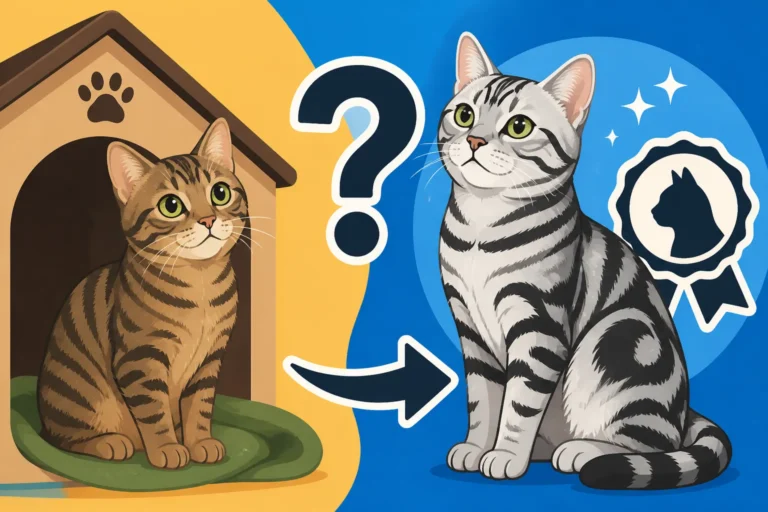
Practical shopping and breed verification are separate matters. Chewy can be a place to look for routine cat supplies, but it cannot establish that a cat is pedigreed; ask the breeder or registry for the appropriate records. If you are deciding between a pedigreed cat and a lookalike, How to Tell an American Shorthair From a Random Bred Tabby explains why resemblance alone is not enough.
The key takeaway is context, not a simple list
The British Shorthair and Persian are among the breeds most often associated with American Shorthair outcrossing discussions. Burmese, Russian Blue, and Siamese cats also appear in some accounts, but their mention should not be taken to mean every breed played the same role or that every claim describes a documented, routine breeding practice. Some sources discuss a direct outcross; others blur that with shared ancestry or general influence.
So, when you encounter a claim about an American Shorthair outcross, look for the details behind it. Which breed was involved? Was the claim about a specific mating, a historical population, or a similar appearance? Does it refer to a particular line or to the breed as a whole? Those questions make the history clearer—and prevent an old breeding practice from being mistaken for proof of a modern cat’s parentage.
For readers preparing to bring a cat home, Chewy and other retailers can help with practical items such as food bowls, litter, and carriers, but pedigree questions belong with breeder and registry documentation. Keeping those purposes separate makes it easier to appreciate the American Shorthair’s complex history without turning a useful breed story into an unsupported claim about an individual cat.
Disclaimer
This article is for general informational purposes only and does not constitute professional advice. Laws, prices and regulations vary by location and change over time. Consult a qualified professional for guidance on your specific situation.