Whether a DNA Test Tells an American Shorthair From a Moggy
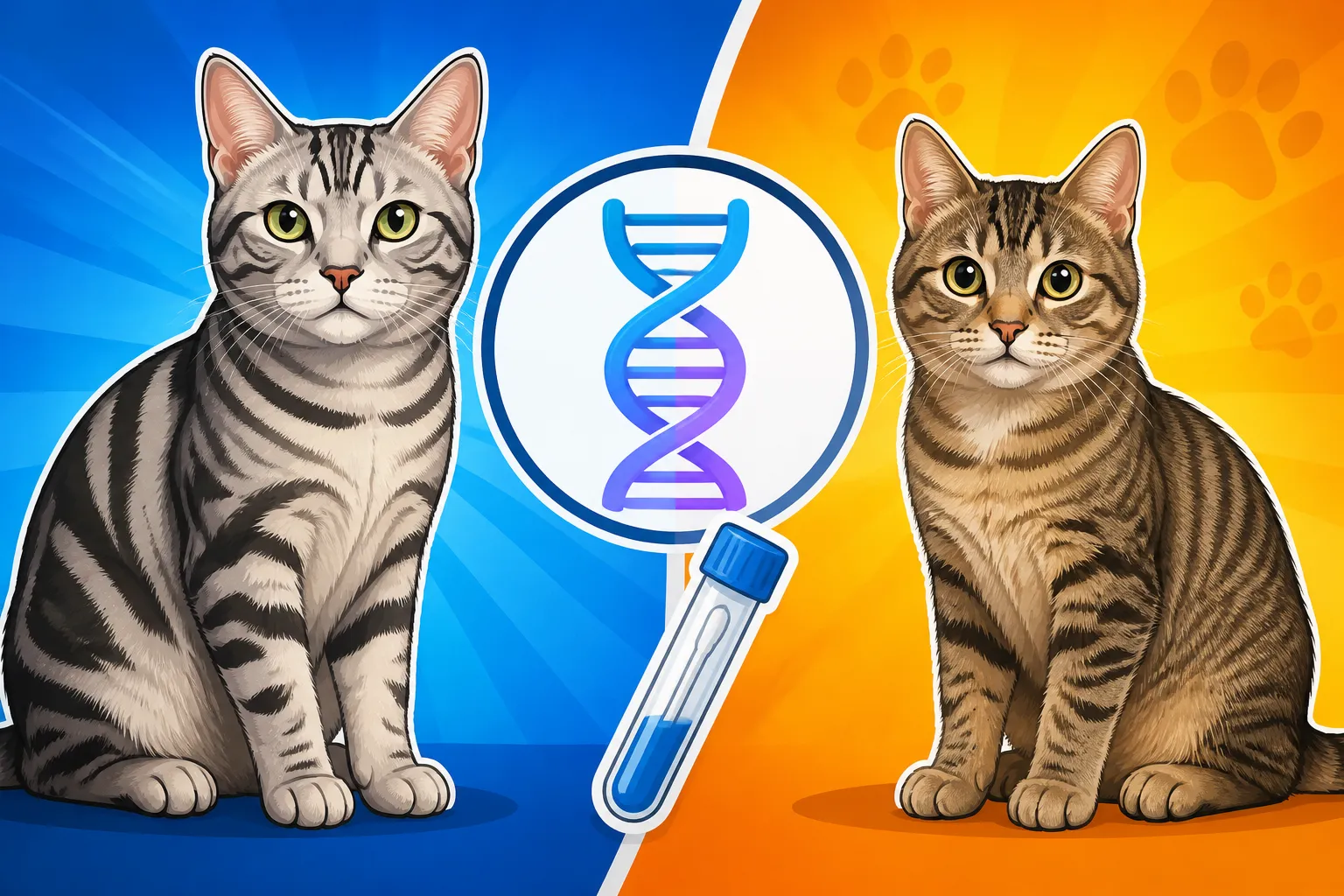
A DNA test may reveal parts of your cat’s ancestry, but it usually cannot prove that an American Shorthair is a pedigreed cat—or reliably distinguish one from a domestic shorthair moggy. That can be disappointing when a cat has the classic round face and sturdy build. This guide explains what feline DNA tests can tell you, what they cannot, and what evidence matters for breed identification.
What a cat DNA test can reveal
Ancestry estimates are not a breed certificate
Most at-home cat DNA tests compare selected parts of a cat’s genetic material with reference groups used by the test provider. The results may suggest that your cat shares genetic similarities with certain breeds or regional cat populations. They can also report genetic relatives or broad ancestry patterns, depending on the test.
That is different from proving that a cat belongs to a recognized pedigree breed. A test result is an estimate based on the reference samples and methods available to that provider; it is not the same as a documented family tree. Even a result that names American Shorthair ancestry does not, by itself, show that the cat’s parents were registered American Shorthairs or that the cat is eligible for registration.
This distinction matters because “looks like an American Shorthair” and “is a registered American Shorthair” are not interchangeable claims. The breed is defined through documented lineage and registry rules, not just a collection of physical traits. For a fuller explanation of that difference, see How an American Shorthair Differs From a Domestic Shorthair.
Why breed matching can be difficult
Many cat breeds are relatively recent in comparison with the long history of domestic cats. Some share ancestry, and many physical features—such as a short coat, tabby markings, a broad face, or a solid build—occur in cats without a pedigree. A domestic shorthair can look remarkably like an American Shorthair without being one.
Test results also depend on the reference populations a company uses. If a database has limited samples for a particular breed, or if a cat’s ancestry does not closely match the samples, the test may return a broad or uncertain result. Different companies may categorize the same cat differently because their reference groups and interpretation methods are not identical.
That does not necessarily mean a test is useless. It may provide interesting clues about ancestry or identify certain genetic variants. But a breed label in a report should be read as a genetic estimate, not a definitive identity card. The history and development of the breed help explain why appearance alone can be misleading; Where the American Shorthair Comes From offers more context.
Can a DNA test tell an American Shorthair from a moggy
A result cannot reliably certify purebred status
A DNA test may detect genetic similarities associated with American Shorthairs, particularly when the cat’s ancestry is closely related to the reference cats in the test’s database. But a positive-looking result does not establish a complete pedigree. It cannot automatically confirm that the cat’s parents and grandparents were American Shorthairs, or that the cat meets a registry’s requirements.
The reverse is true, too. A test that does not identify American Shorthair ancestry does not necessarily prove that a cat has no such ancestry. A result can be affected by the test’s reference data, the cat’s mixed background, and how the company groups genetic similarities. “Not detected” and “definitely absent” are not always equivalent.
This is especially relevant for rescue cats. A shelter may describe a cat as an American Shorthair type because its appearance resembles the breed, not because it has registration papers. A DNA result might add information about ancestry, but it cannot replace missing pedigree records. If you are considering a rescue, Whether a Shelter Tabby Can Be Registered as an American Shorthair explains why resemblance and registration are separate questions.
Appearance and ancestry both have limits
The American Shorthair standard describes a particular overall type, including a sturdy body and a balanced head. Those traits can help people recognize the breed, but they are not unique genetic markers that a home test can simply scan for. A cat with a thick build and classic silver tabby coat may be a domestic shorthair, while a pedigreed American Shorthair may have a different coat color or pattern.
Here is a practical way to interpret common kinds of evidence:
| Evidence | What it can tell you | What it cannot establish on its own |
|---|---|---|
| Physical appearance | Whether a cat resembles the breed’s general type | Pedigree or registration |
| At-home DNA report | Possible ancestry patterns and selected genetic findings | Definitive purebred status |
| Registration paperwork | Whether a cat is recorded under a registry’s rules | A guarantee of health or temperament |
| Breeder records | Parentage and documented lineage, when complete and verifiable | That every health concern has been ruled out |
| A combination of records and DNA | More context about identity and ancestry | A substitute for registry requirements |
A DNA test can be one piece of a broader picture, but it is not the deciding piece when the question is whether a cat is a pedigreed American Shorthair. To understand what registration documents do and do not establish, see What an American Shorthair Pedigree Guarantees.
Choosing and interpreting a feline DNA test
Check the test’s purpose before buying
Before ordering a kit, decide what question you want answered. If you are curious about possible ancestry, look for a test that clearly explains how it describes breed or population estimates and what its confidence levels mean. If your main concern is a health condition, check whether the test actually includes the relevant genetic variant and discuss the result with a veterinarian. Those are different purposes, and a test designed for one may not answer the other well.
If you are comparing home-testing kits through a retailer such as Chewy, read the laboratory’s description of its methods and limitations rather than relying only on the product title or a short sales summary. A retailer listing can help you find a kit, but it cannot make an ancestry estimate equivalent to a pedigree. If you see a test described as identifying a breed, look for an explanation of whether it reports similarity, ancestry, or documented lineage.
Chewy may be one place people browse while comparing pet products, but the important questions are about the testing company behind the kit: what is analyzed, what the report actually claims, how uncertain findings are explained, and whether the company distinguishes ancestry from breed certification. Check the provider’s own materials for current details before deciding.
Treat health findings as screening information
Some feline DNA tests include health-related findings, such as whether a cat carries a particular genetic variant. A result may be useful context, but it does not necessarily predict whether a cat will develop a disease. Many health conditions involve multiple genes, age, environment, and other factors. A test that checks a limited set of variants cannot rule out every inherited or acquired problem.
A “clear” result should therefore be interpreted narrowly: it may mean that the tested variants were not detected, not that the cat is free of all possible health risks. Likewise, a positive result may call for a conversation with a veterinarian rather than a self-made diagnosis. The veterinarian can help put the finding in context with the cat’s symptoms, history, and examination.
If you are evaluating health information about a pedigreed cat, ask the breeder for relevant records and discuss what testing is appropriate with your vet. A breed’s general reputation is not a substitute for individual health assessment. For more on the distinction between breed identity and genetic screening, see Whether a DNA Test Confirms an American Shorthair and What an American Shorthair Pedigree Predicts About Health.
What to do if you want to know your cat’s breed
Start with records, not a visual guess
If your cat came from a breeder and you want to confirm its breed, ask for registration documents and a pedigree that can be checked with the relevant registry. The paperwork should connect the cat to its parents and ancestry, rather than simply state that the cat “looks purebred.” You can also ask the breeder which registry recorded the litter and what documentation accompanies the kitten.
If you adopted your cat, contact the shelter or rescue to ask what they know about the cat’s history. They may have intake notes or information from a previous owner, but many cats arrive without reliable lineage records. In that case, it is reasonable to describe the cat as an American Shorthair type if that is what it resembles, while recognizing that this is a description rather than proof of pedigree.
A DNA test may satisfy curiosity, but decide in advance how you will use the result. If you simply want a fun ancestry clue, an estimate may be interesting. If you need proof for registration, breeding, or a formal record, ask the registry what documentation it accepts before spending money on a test. Requirements depend on the registry, and a consumer DNA report may not meet them.
Keep the cat’s care separate from its label
For everyday ownership, the difference between a pedigreed American Shorthair and a lookalike moggy often matters less than the individual cat in front of you. Your cat’s age, weight, behavior, medical history, and needs are more useful for making routine care decisions than an ancestry percentage. A DNA report cannot tell you exactly how your cat will behave or what health issues it will experience.
If a test reveals something unexpected, save the report and bring it to your veterinarian. Ask what the finding means for this particular cat and whether any follow-up is recommended. If the report only offers an ancestry estimate, it may not require any change in care. Avoid making medical, breeding, or dietary decisions based solely on a breed label or a single genetic result.
In short, a DNA test can offer clues, but it generally cannot tell you with certainty that a cat is an American Shorthair rather than a moggy. Pedigree records are the stronger evidence of registered breed identity; DNA results are best treated as additional context. For a related look at breed identification, see How to Tell an American Shorthair From a Random Bred Tabby.
Disclaimer
This article is for general informational purposes only and does not constitute professional advice. Laws, prices and regulations vary by location and change over time. Consult a qualified professional for guidance on your specific situation.