Whether the Scottish Fold Used the American Shorthair
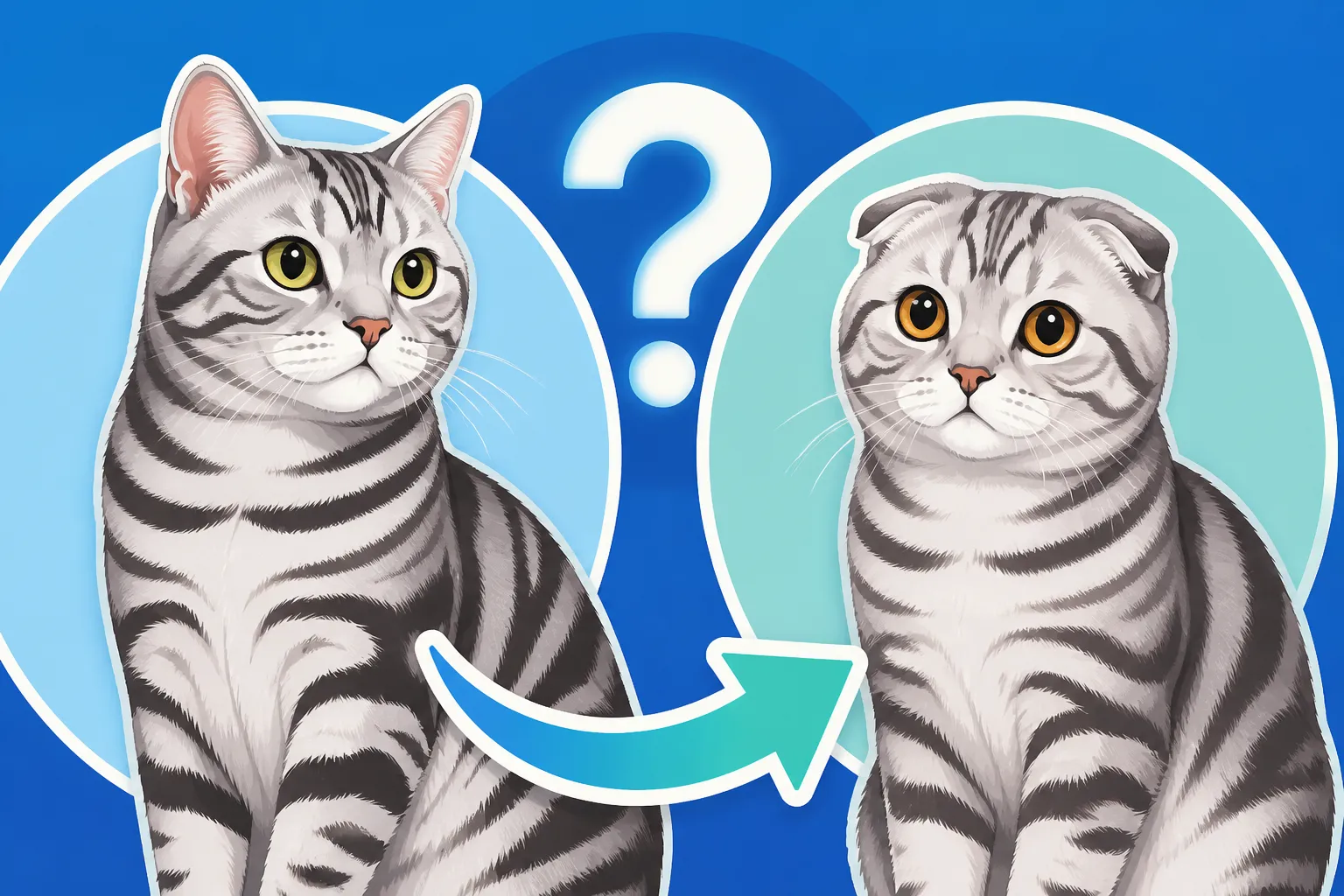
A Scottish Fold’s folded ears look distinctive, but they come from a cartilage mutation—not from the American Shorthair. The American Shorthair did have a role in the Scottish Fold’s development as an outcross breed, helping expand breeding options after the first Fold cats were discovered in Scotland. Here’s what that connection means, and what it does not mean, for the cats’ ancestry and health.
How the American Shorthair Entered Scottish Fold Breeding
The Scottish Fold began with a spontaneous mutation
The Scottish Fold story starts with a farm cat named Susie, discovered in Scotland in the early 1960s. Her ears folded forward because of a naturally occurring genetic mutation affecting cartilage. Breeders developed the Scottish Fold from cats carrying that trait; the breed was not created by crossing an American Shorthair with another cat.
That distinction matters because a breed’s foundation and its later outcrosses are different parts of its history. Susie and the early Fold cats established the defining ear trait. Other breeds were subsequently used in planned matings to support the developing population and broaden the available breeding stock.
If you’re sorting through breed histories, it helps to keep the American Shorthair’s own background separate from its contribution elsewhere. Its history includes working cats and later show breeding, as described in The Mayflower Cats Behind the American Shorthair and Which Breeds the American Shorthair Was Outcrossed To. Neither history means that every cat with a similar appearance shares the same ancestry.
American Shorthairs were used as outcrosses
Yes, American Shorthairs have been used in Scottish Fold breeding programs. An outcross is a planned mating between cats of different breeds, permitted under the relevant registry’s rules. In Scottish Fold programs, American Shorthairs have been one of the breeds used alongside British Shorthairs and other eligible cats.
The purpose of an outcross is not to create the defining trait from scratch. The folded ears already existed in the Scottish Fold population. Instead, outcrossing can introduce additional breeding options and widen the pool of cats available to a program. The offspring may have folded or straight ears depending on whether they inherit the Fold-associated mutation.
The American Shorthair’s use in a Scottish Fold program does not make the two breeds interchangeable, and it does not mean that all Scottish Folds have a recent American Shorthair parent. The specific ancestry depends on the cats in a particular pedigree and the rules followed by its breeder and registry.
The American Shorthair was not the source of folded ears
A common point of confusion is assuming that a breed used in an outcross must have supplied the defining feature. That is not what happened here. The folded-ear mutation was identified in the early Scottish Fold population, not introduced by American Shorthairs.
An American Shorthair used in an outcross would generally contribute traits from its own family line, while the Fold-associated ear trait could come from the Scottish Fold parent. A kitten’s appearance alone cannot tell you the full pedigree, and a folded ear is not proof of American Shorthair ancestry.
This is similar to the way breed histories can involve multiple populations without erasing their differences. The American Shorthair’s own relationship to other shorthaired cats is a separate topic; How an American Shorthair Differs From a Domestic Shorthair explains why a similar coat and build do not establish a cat’s pedigree.
What an Outcross Changes and What It Does Not
Outcrossing adds ancestry, not a new breed identity by itself
When an American Shorthair is included in a Scottish Fold breeding program, the kittens’ ancestry reflects that mating. Their registration status, however, depends on the registry’s rules, the parents’ eligibility, and the program’s documentation. Breed standards and permitted outcrosses can differ among registries, so a blanket claim that every organization treats these matings identically would be misleading.
A careful pedigree records the cats and generations behind a kitten. If you are considering a Scottish Fold, ask which registry is involved, which outcrosses it permits, and how the kitten’s parents and ancestry are recorded. Ask for the actual paperwork rather than relying on a seller’s description such as “part American Shorthair” or “purebred.”
It is also worth separating registry rules for the Scottish Fold from rules for the American Shorthair. The latter has its own history of controlled outcrossing and its own current restrictions. Whether Outcrossing Is Still Allowed in the American Shorthair and What an American Shorthair Is Next to a Domestic Shorthair cover those questions from the American Shorthair side.
A kitten’s ears do not reveal its whole pedigree
Scottish Fold litters can include kittens with folded ears and kittens with straight ears. The ear shape reflects whether a kitten inherited the Fold-associated variant; it does not identify every breed represented in the family tree. A straight-eared kitten may still have Scottish Fold ancestry, while a folded-eared kitten is not automatically part American Shorthair.
That makes breeder records especially important. Ask to see the pedigree and clarify how the breeder describes each kitten: Scottish Fold, Scottish Straight, or another designation used by the registry. If the breeder claims American Shorthair ancestry, ask where that appears in the documented lineage.
For comparison, the American Shorthair itself is a recognized pedigree breed, not simply a label for any shorthaired cat with a sturdy body. Its formal identity is tied to documented ancestry and breed rules, a distinction explored in How an American Shorthair Differs From a British Shorthair. A general resemblance is not the same thing as a verified family history.
Registry policies can shape the answer
Breed associations may set different rules about acceptable outcrosses, registration, and how offspring are classified. Rules can also change, so a breeder should be able to name the registry they work with and show the relevant documentation for the litter. If two breeders give different answers, they may be following different registry systems rather than describing the same registration pathway.
Before placing a deposit, ask direct, practical questions:
- Which registry will register the kitten?
- Are American Shorthair outcrosses permitted under that registry’s rules?
- What breed designations appear on the kitten’s paperwork?
- Can you review the pedigree and health records for both parents?
- What health concerns does the breeder screen for, and how are results documented?
Clear answers should be specific and supported by records. If the breeder dismisses pedigree questions or uses them to distract from health concerns, take that seriously. The broader history of American Shorthair recognition is covered in The American Shorthair Was One of the CFA's Five Founding Breeds, but a registry’s rules for one breed should never be assumed to govern another.
The Health Issue That Matters More Than the Outcross
Folded ears are tied to a cartilage mutation
The folded ears are not a cosmetic feature separate from health. The mutation responsible affects cartilage, and it can be associated with osteochondrodysplasia, a disorder involving abnormal cartilage and bone development. The degree and timing of problems can vary, but a folded-ear appearance signals a real welfare concern that prospective owners should understand.
Some affected cats may develop stiffness, pain, changes in their gait, or difficulty jumping. Those signs can be subtle at first: a cat that stops climbing onto a favorite perch, seems reluctant to play, or moves less after resting may not simply be “calming down.” A veterinary assessment is appropriate if you notice changes in comfort or mobility.
An American Shorthair outcross does not remove the mutation from a folded kitten. Nor does a more varied pedigree guarantee that a cat will be free of the condition linked to the Fold trait. Ancestry can tell you about family relationships; it cannot make a health risk disappear.
Ask about welfare practices, not just breed labels
If you are talking with a Scottish Fold breeder, ask how they make breeding decisions with the cats’ welfare in mind. Get a clear explanation of the parents’ ear types, health history, veterinary care, and the registry’s breeding rules. A responsible discussion should acknowledge the mutation and its potential consequences rather than presenting folded ears as an uncomplicated feature.
Be cautious of claims that a kitten is “safe” solely because one parent is an American Shorthair, or that a particular cross guarantees a problem-free Fold. The parent’s breed does not, by itself, establish the health outcome for an individual kitten. Ask the breeder to explain the evidence behind any health claim and to provide records that can be reviewed with your veterinarian.
This is also a good moment to consider whether the appearance is worth the associated welfare trade-off. People often fall for the folded ears in photos and only later learn that the same trait is connected to cartilage development. It is reasonable to pause, ask questions, and decide that a different cat is a better fit for your values.
Plan care around the individual cat
Whatever the pedigree, a cat’s daily comfort depends on observing how it moves and behaves. Provide easy access to food, water, litter, and resting places, especially if jumping becomes difficult. A low-entry litter tray and stable steps to a favorite sofa can make ordinary routines less demanding. Your veterinarian can help assess mobility changes and recommend an appropriate care plan.
For a new cat, organize basic supplies before arrival. Some owners compare options at a retailer such as Chewy when putting together food, litter, and carrier essentials, while checking with the breeder or veterinarian about suitable choices. A retailer can help with household supplies, but it cannot replace veterinary advice or the health documentation that should accompany a kitten.
If a cat’s needs change, practical adjustments may matter more than elaborate accessories. A second water station, a litter tray on the floor the cat already uses, or a ramp to a familiar resting spot may reduce strain. Chewy is one place owners may browse for basic cat-care items, but confirm that a product fits the cat’s size and needs rather than buying based on a breed label alone.
How to Evaluate a Scottish Fold’s Ancestry
Read the pedigree as a record, not a health guarantee
A pedigree can show whether an American Shorthair appears in a Scottish Fold’s ancestry and how recently that cross occurred. It cannot predict every trait or certify that a cat will remain free of disease. Treat it as one useful part of the picture, alongside veterinary records, screening information, and a frank conversation about the Fold mutation.
When a breeder says “American Shorthair was used,” ask whether they mean a specific parent, a more distant ancestor, or a general historical fact about the breed. Those are different claims. A traceable pedigree should make the distinction clear, rather than leaving you to infer ancestry from a kitten’s round face, coat, or body shape.
The same care applies to claims about the American Shorthair itself. The breed’s early history is sometimes simplified into a single origin story, but its development involved changing populations and breeding decisions. What People Get Wrong About the American Shorthair is a useful companion read if you are comparing breed stories and trying to separate documented history from assumptions.
Use a straightforward breeder checklist
A concise set of questions can prevent a lot of confusion. Before deciding, ask the breeder to identify the registry, show the kitten’s pedigree, explain any American Shorthair ancestry, and provide the available health documentation. Ask what signs of pain or mobility difficulty they watch for in Fold cats and what support they offer if a kitten develops a health problem.
Look for answers that are transparent and consistent. A breeder who welcomes questions should be able to explain why a particular outcross was used and how the kittens are registered. Be wary of pressure to make a quick decision, vague promises that a cross “fixes” the Fold mutation, or a refusal to discuss the welfare implications of folded ears.
Once a kitten is home, share the pedigree and health records with your veterinarian. Keep an eye on movement and behavior over time, and describe changes plainly: “She no longer jumps onto the chair” is more useful than “She seems a little lazy.” For planning the home setup, Chewy may be one option for comparing everyday supplies, but the cat’s comfort and veterinary guidance should lead the decisions.
| Question | What the answer can tell you | What it cannot prove |
|---|---|---|
| Was an American Shorthair used in the breeding program? | Whether that breed appears in the documented ancestry | That every Scottish Fold has American Shorthair ancestry |
| Is the kitten folded-ear or straight-ear? | Whether the visible Fold-associated trait is present | The kitten’s complete pedigree or future health |
| Which registry records the kitten? | Which rules and breed designations apply | That the kitten is free from health risks |
| Are health records available for the parents? | What information the breeder can document | A guarantee that the kitten will never develop illness |
| Does an outcross eliminate the Fold-related concern? | Nothing, if the claim is made without evidence | That folded ears are risk-free |
The practical answer is that the American Shorthair was used as an outcross in Scottish Fold breeding, but it did not create the Scottish Fold’s folded ears. For an individual kitten, rely on documented pedigree and health records—not appearance or a broad claim about breed history. And when considering a Fold, weigh the distinctive look against the welfare concerns tied to the mutation itself.
Disclaimer
This article is for general informational purposes only and does not constitute professional advice. Laws, prices and regulations vary by location and change over time. Consult a qualified professional for guidance on your specific situation.