Whether the American Shorthair Is Bred in Asia
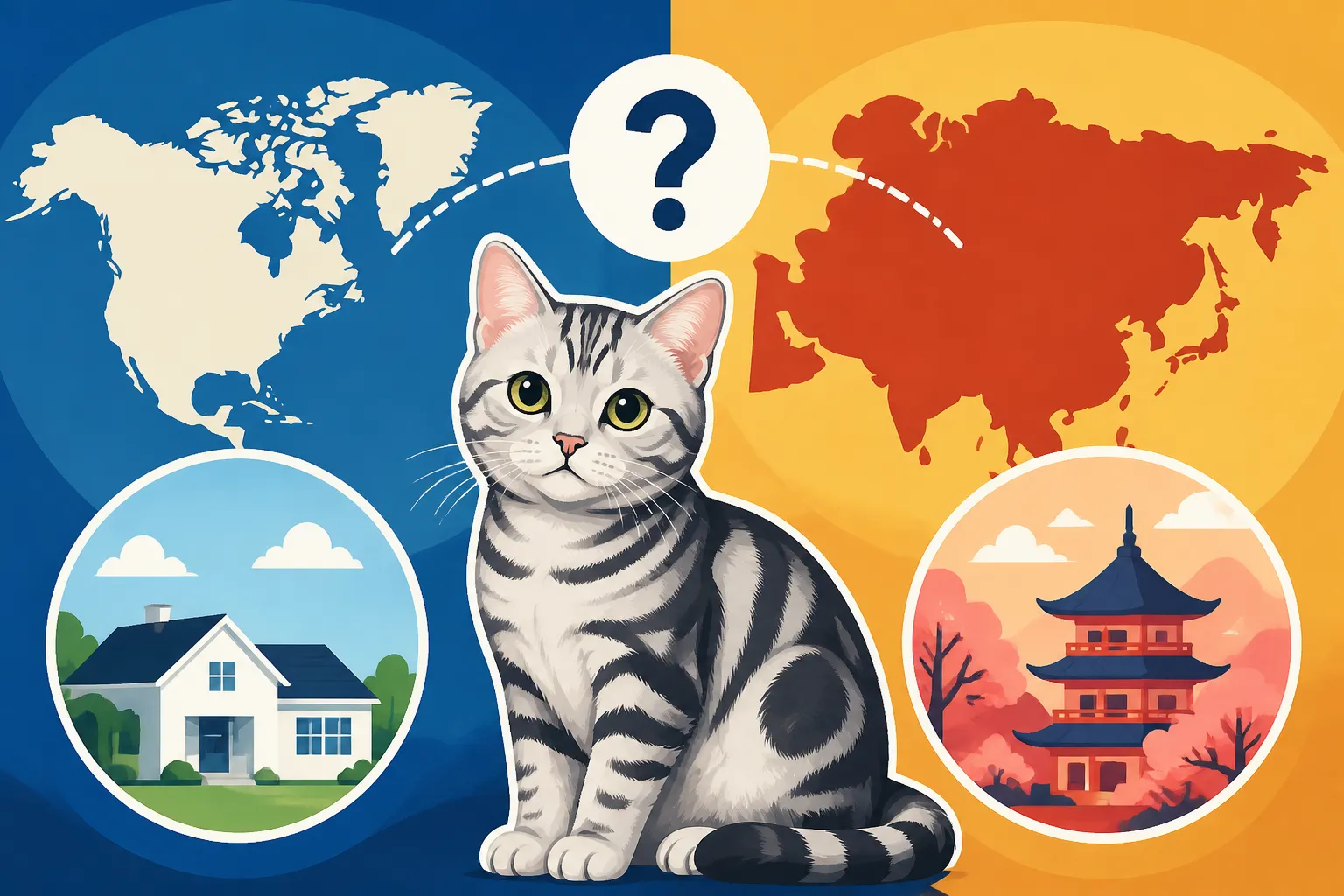
The American Shorthair began in North America, but the breed is not confined to it. If you are wondering whether breeders raise American Shorthairs in Asia, the short answer is yes: cats of this breed can be bred there, too. The important distinction is between where a cat is born and whether its pedigree and registration support the breed name.
American Shorthairs can be bred outside the United States
The breed’s name describes its history, not a birthplace requirement
The American Shorthair developed in North America from working cats valued for their strength and ability to catch rodents. Over time, breeders established a recognizable breed type and pedigree records. Its name reflects that history; it does not mean every American Shorthair must be born in the United States.
A kitten born in Japan, South Korea, China, or another Asian country could be an American Shorthair if it comes from documented American Shorthair parents and is registered under the relevant rules. The breeder’s location alone neither proves nor disproves the kitten’s breed. In the same way, a cat born in the United States is not automatically a pedigree American Shorthair just because it resembles one.
This distinction matters because the breed can look similar to many shorthaired cats. A silver tabby from a shelter may have the familiar coat pattern and sturdy appearance, but looks alone do not establish a recorded pedigree. For a closer look at that difference, see How an American Shorthair Differs From a Domestic Shorthair.
Breed standards and registries matter more than geography
A breed standard describes the traits breeders aim to preserve, such as overall body structure, coat, head shape, and permitted colors. Registration records connect a kitten to its parents and earlier generations. Those records are what help establish that the cat belongs to a recognized pedigree breed, rather than simply resembling one.
Registration arrangements can differ between countries and organizations. A breeder may work with an international registry, a national cat association, or more than one body. If you are considering a kitten, ask which registry records the litter and how you can verify the registration. The name of a registry on a website or sales listing is not a substitute for documents tied to the particular kitten.
It is also useful to distinguish registration from quality. Papers can document ancestry, but they do not, by themselves, guarantee good health, responsible breeding, or a suitable temperament. Those questions depend on the breeder’s practices, the parents’ health information, the kitten’s care, and the transparency of the sale.
Asian breeding does not make the cat a different breed
When a breeder in Asia follows an American Shorthair pedigree and the applicable breed standard, the cat does not become a separate breed simply because it was born abroad. Its place of birth may be listed in its records, but its breed identity rests on lineage and registration rather than the continent where it was raised.
That does not mean every cat marketed as an American Shorthair has equivalent documentation. A seller might use the name informally for a shorthaired tabby with a similar look. When a listing uses phrases such as “American Shorthair type” or “American Shorthair mix,” treat those descriptions as different from a registered pedigree claim and ask what paperwork is available.
For more context on how the breed became formally distinguished from the general domestic cat population, see Why the American Shorthair Name Changed in 1966 and Whether a Domestic Shorthair Can Become an American Shorthair.
What to check when you find an Asian breeder
Ask for the kitten’s pedigree and registration details
Start with a simple question: which organization will register the kitten, and what documents will you receive? A responsible breeder should be able to explain how the litter is recorded and show you how the kitten’s identity connects to its parents. Ask whether registration is already completed or whether it will be finalized after the sale.
Request to see the pedigree and the parents’ registration information. Check that the names, identifying details, and litter information match across the paperwork. If you are unsure how to interpret a document, ask the registry named by the breeder to explain its verification process. Avoid relying only on a screenshot, a social media post, or a certificate that does not clearly identify the kitten.
A pedigree is useful, but it is only one part of evaluating a breeder. Ask about the kitten’s veterinary care, vaccination and parasite-control history, socialization, and the conditions in which the cats are kept. You should also be able to ask about the parents’ health and temperament without being pressured to send a deposit immediately.
Evaluate health practices separately from breed claims
A registered pedigree does not mean a kitten has been screened for every possible health concern. Ask what health checks the breeder performs, what the results mean, and whether you can review records for the kitten’s parents. Answers should be specific and understandable, not a vague promise that the line is “perfectly healthy.”
For the American Shorthair, it is sensible to discuss heart health with the breeder and your veterinarian. A genetic test alone cannot rule out every form of heart disease, so ask what examinations have been done and how recently. The details of screening can vary by family line and veterinary advice. The breeder should be willing to explain the approach rather than presenting a test result as a guarantee.
You can read more about records and screening in What an American Shorthair Breeder Should Have Screened and What an American Shorthair Breeder's Echo Paperwork Should Say. These topics are relevant whether the breeder is in the United States or Asia: the questions about health documentation do not change with the kitten’s country of birth.
Look for transparency, not just polished listings
A careful breeder will usually ask you questions, too. They may want to understand your home, household routine, other pets, and plans for veterinary care. That conversation is not an inconvenience; it helps determine whether the kitten is likely to fit your circumstances and whether the breeder is taking responsibility for where their cats go.
Ask whether you can meet the kitten in person or see a live video showing the kitten with its mother and littermates. If a visit is not possible, request clear, current information and a written agreement. Be cautious if the seller refuses to answer basic questions, will not identify the registry, offers several breeds or litters with no meaningful details, or pressures you to pay through an unusual method.
International distance can make it harder to assess a breeder, so take time to verify names, documents, and communication channels. A good-looking website is not proof of responsible breeding. Nor is a high price proof of quality. Compare the evidence, ask follow-up questions, and be prepared to walk away if key details remain unclear.
Buying across borders and bringing a kitten home
Confirm the rules before paying a deposit
If you live in a different country from the breeder, check the import and entry requirements that apply to your destination before making a commitment. Requirements can involve identification, veterinary documents, vaccinations, permits, or other steps, and they can depend on the countries involved and the kitten’s age. Do not assume the breeder or shipping company will handle every requirement on your behalf.
Ask the breeder for a written outline of what they will provide and what you must arrange. Clarify whether the kitten will travel with its registration documents, health records, and a sale agreement. Make sure the kitten’s microchip or other identification information, if applicable, matches the records. If travel plans change, know who is responsible for care and communication.
It is worth speaking with a veterinarian or the relevant animal-import authority before you send money. This helps prevent a stressful situation in which a kitten is ready to travel but paperwork, timing, or entry conditions are not in order. A legitimate breeder should understand why you need clear answers before committing.
Plan for the kitten’s transition after arrival
Whether the kitten travels a short distance or across borders, give it a quiet place to settle. Set up food, water, litter, a comfortable hiding spot, and a secure room before arrival. Keep the first days calm, especially if the kitten has experienced transport, unfamiliar people, or a change in climate and household noise.
Ask what food the kitten is currently eating and make any dietary transition gradually, with veterinary guidance if needed. Before arrival, you can gather routine supplies from a local pet shop or an online retailer such as Chewy, where available. Focus on practical basics—food, litter, bowls, a carrier, scratching surfaces, and safe toys—rather than buying a large collection of items before you know what the kitten prefers.
Book an introductory veterinary visit and bring the breeder’s records. The vet can review the kitten’s health, discuss preventive care for your location, and help you make a plan for future checkups. If the kitten seems unusually tired, refuses food, has breathing trouble, or shows other worrying signs after travel, contact a veterinarian promptly rather than assuming it is only adjusting.
How to judge an American Shorthair listing in Asia
Separate a registered pedigree from a lookalike
A listing should make clear whether the kitten is registered as an American Shorthair, sold as an American Shorthair type, or described as a mix. Those terms are not interchangeable. If the seller claims the kitten is registered, ask for the name of the registry and documents specific to the kitten and its parents.
A useful comparison is:
| Listing description | What it generally tells you | What to ask |
|---|---|---|
| Registered American Shorthair | The seller claims documented pedigree registration | Which registry records the kitten, and what paperwork will you receive? |
| American Shorthair type | The cat may resemble the breed, but the phrase alone does not establish pedigree | Is there a documented pedigree, or is this a description of appearance? |
| American Shorthair mix | The cat is represented as having mixed ancestry | Which parent is the American Shorthair, and is that parent registered? |
| Silver tabby or shorthaired tabby | Coat pattern or general appearance, not proof of breed | Is the cat being sold as a domestic shorthair or as a registered pedigree? |
A seller may use familiar breed language simply because buyers search for it. That does not automatically mean the seller is dishonest, but it does mean you should clarify exactly what is being offered. If papers are unavailable, do not treat photos or a DNA result as a replacement for a documented pedigree. For the limits of appearance-based identification, see Whether DNA Test Tells an American Shorthair From a Moggy and Whether Papers Are the Only Difference an American Shorthair Has.
Recognize regional availability without assuming every country has the same market
American Shorthairs are known beyond North America, and breeding or ownership may occur in Asian markets. But availability is not uniform across the continent. A country may have a small number of breeders, imported cats, local breed clubs, or only occasional listings. The number of sellers you find online does not necessarily indicate how established or well-documented the local breeding population is.
The terminology and registration routes can also differ by location. A breeder may advertise internationally, while the registry, contract, and veterinary records follow practices specific to their country. That is why buyers should verify the individual litter rather than assuming that every listing in a particular region follows the same standards.
For broader context, Whether the American Shorthair Is Popular in Japan and Which Registries Recognize the American Shorthair can help frame questions about regional presence and documentation. The key point remains straightforward: an American Shorthair can be bred in Asia, but a buyer should verify the pedigree, registration, health information, and breeder practices for the specific kitten.
Decide whether importing is right for you
Buying from a distant breeder can widen your options, especially if local availability is limited. It can also add practical complications: travel coordination, additional documentation, fewer chances to meet the kitten, and less direct follow-up if a question arises after the sale. Those trade-offs are worth considering before you fall in love with a particular kitten’s photos.
A local breeder or rescue may make it easier to visit, meet the cat, and discuss ongoing support. On the other hand, an overseas breeder may be a good fit if they communicate clearly, provide verifiable documents, follow sound welfare practices, and help you understand the travel process. Geography should be one factor in the decision, not the only one.
You do not need to find a breeder in the United States to find a genuine American Shorthair. You do need evidence that the cat is what the seller says it is, and enough transparency to feel comfortable about how it was raised. That careful approach is more useful than assuming either that Asian-born kittens cannot be American Shorthairs or that every cat sold under the name is a registered one.
Disclaimer
This article is for general informational purposes only and does not constitute professional advice. Laws, prices and regulations vary by location and change over time. Consult a qualified professional for guidance on your specific situation.