Whether the Silver Tabby Is the Commonest American Shorthair
A silver tabby is the American Shorthair most people picture, but being famous is not quite the same as being statistically the most common. The tricky part is that breed descriptions and show photos often emphasize this striking pattern, while reliable, complete counts of registered cats by color are hard to find. This guide separates what is well established from what is simply likely.
Is the silver tabby the commonest American Shorthair?
The silver tabby is one of the breed’s best-known looks, and it is widely seen in breeder pages, show materials, and general descriptions of the American Shorthair. But there is an important distinction between “the most recognizable” and “the most numerous.” Without comprehensive, comparable registration data covering every American Shorthair’s color and pattern, it is difficult to prove that silver tabbies outnumber all other varieties.
That does not make the idea baseless. Silver tabbies are prominent enough to be closely associated with the breed, and many people first encounter the American Shorthair through that particular coat. Still, prominence in photographs and advertising can make a variety seem more common than it is across the entire population.
Why silver tabbies are so strongly associated with the breed
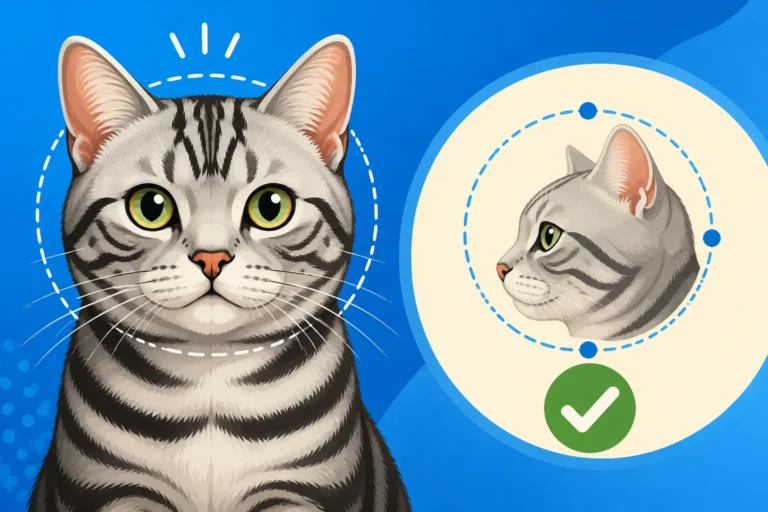
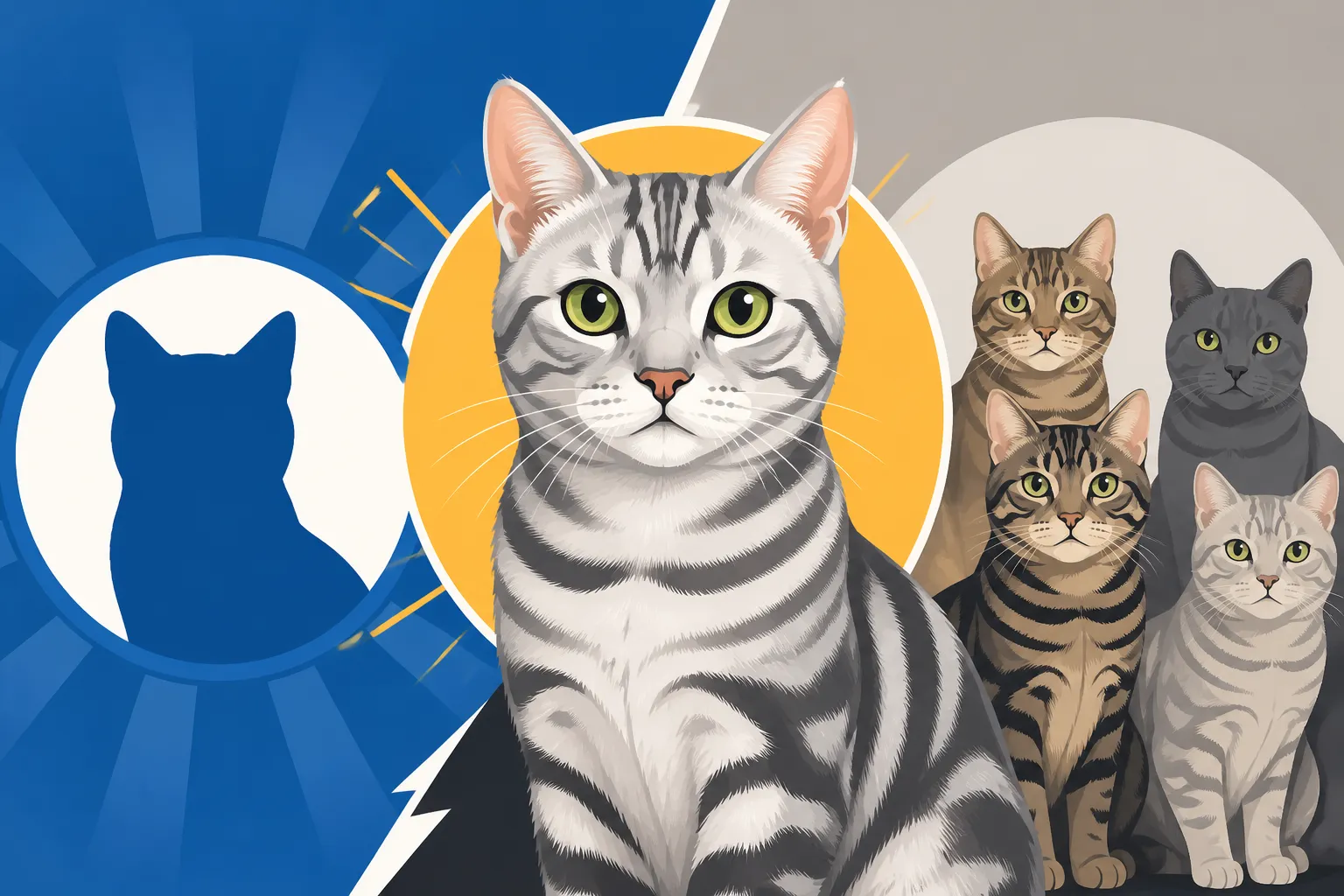
The silver tabby has a crisp, high-contrast appearance: a pale silver background with darker markings that can form bold stripes, swirls, or other tabby patterns. Its clear visual contrast makes the coat easy to notice in a photograph or at a show. In a group of cats, a well-marked silver tabby tends to catch the eye.
That visibility matters. A color that photographs well can become the image people associate with a breed, even if the breed also comes in many other colors and patterns. The silver tabby has become a familiar shorthand for the American Shorthair, much as a particular coat color can become closely tied to other breeds in the public imagination.
If you want to understand how that association developed, Why the Silver Tabby Became the American Shorthair's Face offers more context. It is useful to keep the two questions separate: “Which coat do people recognize?” and “Which coat is most numerous?” The first has a clear answer; the second is harder to establish.
What would count as proof that it is the most common?
To confidently rank coat varieties, you would need consistent records that count American Shorthairs by color and pattern across a defined population. A breeder’s current litters, a show catalog, or a set of online listings can tell you what is visible in that particular sample. None automatically represents every registered American Shorthair, let alone every cat of the breed living in homes.
Even official registration records may not offer a simple public tally that answers the question. Records can differ in what they classify, how detailed their color categories are, and which cats are included. A count that groups several tabby varieties together, for example, cannot be compared directly with one that lists each pattern separately.
So the most careful answer is: silver tabbies are among the most prominent and commonly encountered American Shorthairs, but it is difficult to establish that they are definitively the commonest. The breed’s visual identity is clearer than its exact color-by-color population statistics.
Popularity, visibility, and actual numbers are different things
A popular color can appear to be everywhere because it is featured repeatedly in photos, breeder promotions, and articles. That repetition is a kind of visibility bias. A less familiar color may be just as valid within the breed standard while appearing less often in the examples people happen to see.
Think of a person browsing cat listings online. If the first several American Shorthairs shown are silver tabbies, it is natural to assume that most American Shorthairs look that way. But the listings may reflect what a particular breeder has available, what a marketplace highlights, or what people tend to photograph—not a representative count of the whole breed.
The same caution applies to local impressions. A shelter in one part of the country may have many brown tabbies and few silver cats, while a breeder’s page elsewhere may show several silver litters. Those snapshots can both be accurate without either describing the breed’s overall color distribution.
What makes a silver tabby look different?
“Silver tabby” describes a coat combination, not a separate breed. The American Shorthair also comes in many other colors and patterns, and tabby markings themselves can look quite different from one cat to another. If you are comparing coat descriptions, Which Colors an American Shorthair Comes In and Which Patterns an American Shorthair Comes In explain the broader variety.
A silver tabby typically has a light, silvery ground color with darker markings. The exact appearance depends on the pattern and the individual cat. Some have rounded swirls across the sides, while others have narrower stripes; facial markings and the shape of the markings also vary.
Silver is the background, tabby is the pattern
It helps to treat “silver” and “tabby” as separate parts of the description. Silver refers to the pale ground color of the coat, while tabby describes the markings. In a silver tabby, the contrast between the pale background and darker pattern gives the coat its distinctive, sharply defined look.
Tabby is not a single pattern. A classic tabby often has broad, curved markings along the sides, while a mackerel tabby tends to show narrower vertical stripes. Individual coats may have variations in how clear, bold, or evenly spaced the markings appear. These differences are normal and do not mean that one cat is more of an American Shorthair than another.
For a closer look at the coat itself, see What a Silver Tabby American Shorthair Is. It can also help to compare the pattern with What a Classic Tabby American Shorthair Is and What a Mackerel Tabby American Shorthair Is rather than assuming that every tabby has the same markings.
A coat color does not establish breed identity
A silver tabby domestic shorthair can look remarkably similar to a silver tabby American Shorthair. Coat color alone cannot prove that a cat belongs to a pedigree breed. The overall body type, head shape, coat characteristics, pedigree records, and breeder documentation all matter when establishing breed identity.
This is one reason online photos can be misleading. A cat may have the classic silver tabby appearance people associate with the American Shorthair, but that resemblance does not confirm its ancestry. A shelter cat with a similar coat may be a wonderful companion without being a registered American Shorthair.
If you are trying to distinguish a pedigreed cat from a lookalike, How to Tell an American Shorthair From a Random Bred Tabby explains what appearance can—and cannot—tell you. For questions about records and registration, Whether a Shelter Tabby Can Be Registered as an American Shorthair is also relevant. A DNA test should not be treated as a substitute for a documented pedigree; Whether a DNA Test Tells an American Shorthair From a Moggy explores that issue further.
Color does not determine personality or care needs
People sometimes expect a silver tabby to have a particular temperament because it is the breed’s most familiar image. In reality, coat color is not a reliable guide to an individual cat’s personality. A cat’s behavior is shaped by a mix of genetics, early experiences, health, and its home environment.
The same goes for care. A silver tabby does not need a special diet or grooming routine simply because its coat is silver. Like other American Shorthairs, it benefits from appropriate portions, routine veterinary care, play, and regular observation of its coat, skin, teeth, and general behavior.
If you are preparing for a cat, focus on practical needs rather than color-specific products. Some owners browse Chewy for basics such as a brush, a sturdy scratching surface, or interactive toys, but the right choices depend on the individual cat and your household. Chewy is a retailer, not a source of proof about a cat’s breed or ancestry.
How to assess claims about American Shorthair colors
When you see a claim that silver tabbies are “the most common,” ask what the claim is based on. Is it a formal count of registered cats, a breeder’s experience, a set of show entries, or simply the number of silver tabbies featured in a particular article? Those are different kinds of evidence and answer different questions.
This is not a reason to distrust every breed description. It is a way to read descriptions more carefully, especially when a statement sounds precise but gives no population or time period. Color is visible; reliable population data may not be.
Check what population is being counted
A claim about the commonest American Shorthair may refer only to registered cats, only to cats shown at events, or only to kittens available from a particular breeder. Each group can have a different mix of colors. A breeder’s experience can be useful for understanding that breeder’s lines, but it should not automatically be generalized to the whole breed.
Also pay attention to how categories are grouped. “Tabby” might include multiple patterns and background colors, while “silver tabby” is a narrower category. If one source combines several varieties and another separates them, their rankings may appear to disagree even though they are counting cats differently.
A practical way to assess a statement is to ask: What cats were included? How were colors classified? Is the information based on a representative dataset or a small sample? If those details are missing, treat the ranking as an impression rather than a proven fact.
Look beyond listing photos and show images
Online photos are useful for seeing the range of coat appearances, but they are not a census. A listing page may show only the cats currently available, and a show gallery may naturally emphasize cats selected for a particular event. Photos are especially likely to feature coat patterns with strong contrast because they are easy to appreciate on screen.
If you are choosing a cat, use photos to learn about appearance, not to estimate the breed’s population. Ask a breeder how they describe the kitten’s color and pattern, and request relevant pedigree information if you are purchasing a registered American Shorthair. If adopting, a shelter’s description may identify a cat as an American Shorthair type based on appearance; that wording is not the same as documented pedigree.
For new owners, shopping for care supplies is a separate task from confirming coat or breed. Chewy may be one place to compare everyday items such as food storage, grooming tools, and toys, but check that any product fits your cat’s needs and follow veterinary guidance for diet or health concerns. A retailer listing cannot verify ancestry, and a coat-color label should not be treated as a health assessment.
Use careful language when describing the answer
If you are writing or speaking about the breed, phrases such as “the most recognizable” or “one of the best-known” are usually safer than “the most common” unless you have a clear, reliable count. That distinction keeps a familiar observation from becoming an unsupported statistical claim.
For a prospective owner, the practical takeaway is simple: a silver tabby is a classic American Shorthair look, but it is not the only correct one. A brown tabby, solid-colored cat, or another accepted variety can still be an American Shorthair. Choose based on the cat’s health, temperament, background, and fit with your household—not on the assumption that the most famous coat is necessarily the most prevalent or the best.
What to remember when choosing a silver tabby
Silver tabbies deserve their reputation: their bright background and strong markings make them especially memorable, and they are strongly associated with the American Shorthair. That visibility explains why they appear so often in breed imagery. It does not, by itself, prove that they are more numerous than every other color and pattern.
If you love the look, it is perfectly reasonable to seek out a silver tabby. Just keep the breed and coat questions separate. A particular color does not prove pedigree, predict personality, or guarantee better health. Ask for documentation when pedigree matters, and evaluate any cat as an individual.
For day-to-day ownership, prepare for the cat in front of you. Chewy can be part of an owner’s routine for finding ordinary supplies, just as other retailers can, but the most important choices are suited to the cat’s size, age, behavior, and veterinary needs. Whether the cat is silver, brown, or another color, good care matters more than matching the image people most often associate with the breed.
Disclaimer
This article is for general informational purposes only and does not constitute professional advice. Laws, prices and regulations vary by location and change over time. Consult a qualified professional for guidance on your specific situation.