How Many Rats an American Shorthair Ancestor Killed at Sea
Have you ever wondered about the tough lives our beloved American Shorthairs' ancestors led, especially those brave felines who served on ships? It’s a fascinating question, and one that often leads to imagining them single-handedly clearing entire infestations. While pinning down an exact number of rats a ship's cat might have dispatched during a voyage is practically impossible, we can certainly delve into the crucial, often grueling, role these cats played in maritime history, and appreciate why their instincts remain so strong today.
The Indispensable Role of Ship Cats: More Than Just Pest Control
Life at sea, particularly in the days of wooden sailing ships, was fraught with peril, and not just from the elements or enemy ships. One of the most persistent and insidious threats came from tiny, scuttling invaders: rats and mice. These rodents weren't just a nuisance; they were a full-blown crisis, making the presence of a cat not merely desirable, but absolutely essential.
Aboard the Mayflower and Beyond: Maritime Pest Control
Imagine a ship like the Mayflower, packed with provisions, cargo, and people, embarking on a long, arduous journey across the ocean. These vessels were essentially floating pantries, offering an endless buffet and perfect breeding grounds for rodents. Rats would chew through ropes, damage wooden structures, contaminate vital food and water supplies, and spread diseases that could decimate a crew far from shore. The sheer volume of foodstuffs, from grains to dried meats, meant that any storage area was ripe for infestation. Without effective pest control, the voyage itself could be jeopardized.
This wasn't just about comfort; it was about survival. A catastrophic loss of provisions due to rat damage could mean starvation for the crew and passengers. Disease outbreaks like the bubonic plague, notoriously carried by fleas on rats, were a constant, terrifying possibility. Sailors understood this grim reality intimately. They knew that a ship could not sail safely or successfully without its feline crew members. Why a Ship Could Not Sail Without an American Shorthair Type Cat was not hyperbole; it was a plain, undeniable truth of maritime life. These cats were truly working animals, earning their keep in the most fundamental way.
The Hunter's Instinct: Natural Predators at Sea
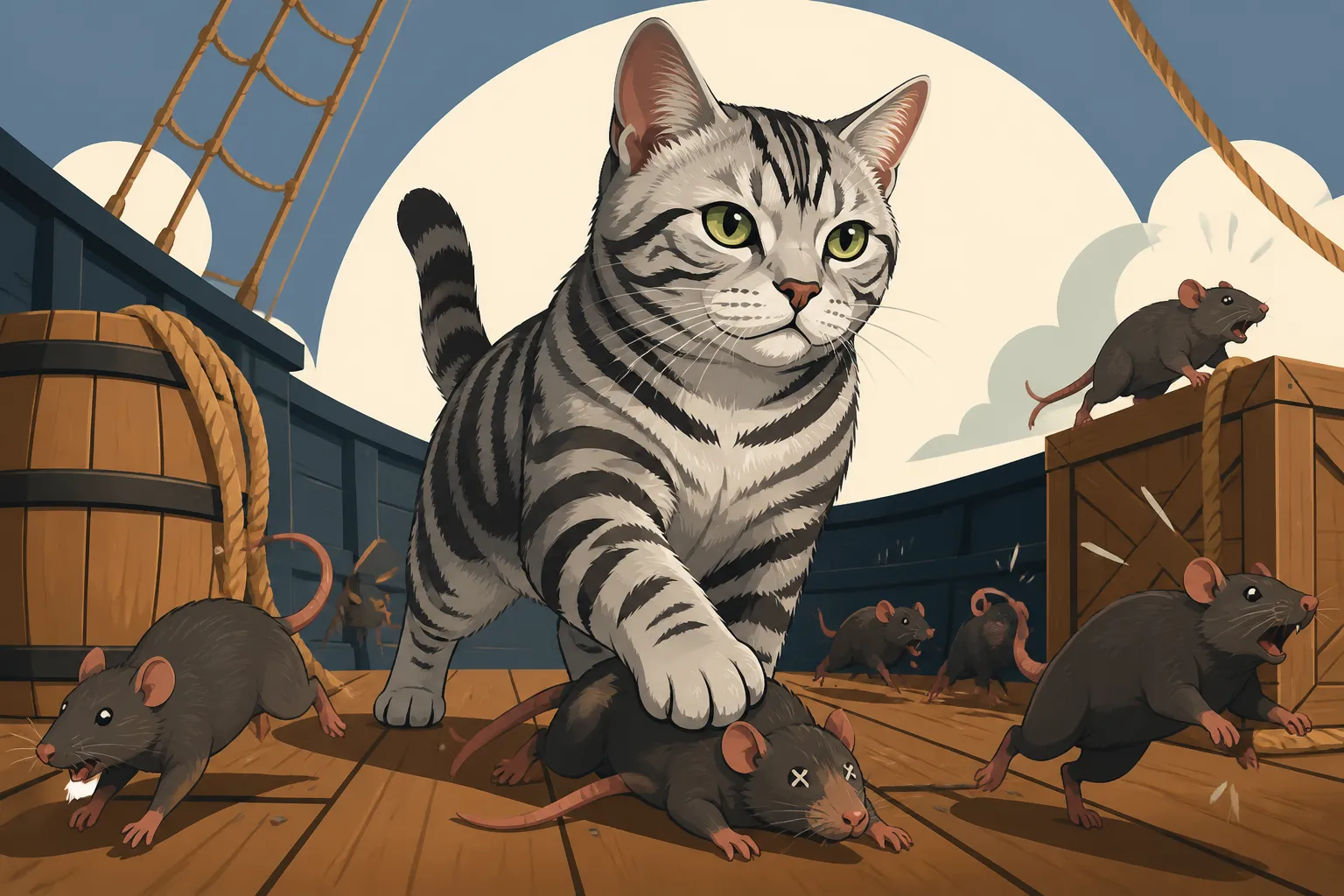
What made cats so uniquely suited for this demanding role? It wasn't just their size or agility, though those certainly helped. It was their primal, unwavering predatory instinct. Long before formal breeds were established, these cats were self-sufficient hunters, hardwired to stalk, pounce, and kill. On a dimly lit, labyrinthine ship, their superior night vision, keen hearing, and acute sense of smell gave them an undeniable advantage over their rodent prey. They could navigate the dark holds, slip through narrow passages, and locate nests hidden deep within the ship's structure, places no human could easily reach.
Consider the alternatives: traps could only catch a few, and poisons were hazardous on a ship where food and water were stored and handled. Plus, dead, poisoned rats could simply rot in inaccessible places, creating new health hazards. A cat, however, offered continuous, organic pest management. They were always on patrol, always alert. Their mere presence, the scent marking they left, and the occasional successful hunt served as a powerful deterrent. It was a constant battle, with new rats potentially boarding at every port, making the cat's vigilance an ongoing, crucial service. These were not pampered pets; they were lean, effective killing machines, a vital component of any successful voyage.
Estimating the Kill Count: Why Specific Numbers Are Elusive
When we think about these brave ship cats, it's natural to wonder about their "scorecard"—how many rats did they actually take down? But the truth is, the answer is frustratingly vague, and for good reason.
The Lack of Formal Records: A Working Cat's Reality
In an era when keeping detailed records of human crew members was often a challenge, expecting a meticulous tally of a cat's daily rat kills is simply unrealistic. These cats were working animals, valued for their results, not their statistics. Sailors weren't pausing their duties to document each catch; they were too busy sailing, navigating, and surviving. A cat's job was simply to do what came naturally, and as long as the rat problem was under control, their performance was considered satisfactory.
Furthermore, a significant part of a cat's effectiveness lies in deterrence. A ship with an active cat presence would likely have fewer rats to begin with because the rodents would sense the predator and choose to stay away or move on. So, while a cat might not have amassed a huge "body count" on a well-managed ship, its silent, ongoing patrol was preventing many more from even becoming a problem. Asking for a precise number is akin to asking for the exact number of raindrops a sturdy umbrella keeps off you; the value is in the prevention, not just the deflected hits. Whether the American Shorthair's Ancestors Were Bought or Kept Free also speaks to this reality – they were often taken on board for their skills, not as a purchased commodity with documented performance.
A Constant Battle: More About Prevention Than a Tally
Think of it less as a daily body count and more as a continuous, active defense system. A single determined ship cat could keep an entire cargo hold virtually free of rodents for months. They weren't just reactive hunters; they were proactive territorial guardians. Their patrols, their marking behavior, and the occasional caught rat sent a clear message to any potential rodent invaders: "This territory is occupied."
Consider a hypothetical scenario: a cat named "Salty" on a merchant vessel. Salty might only bring a dead rat to the crew's attention a few times a week, but that doesn't account for the dozens, perhaps hundreds, of rats and mice that never even dared to venture into the ship's holds or galleys because of Salty's presence. It also doesn't account for the young rats or mice caught and eaten in situ, or the many chases that ended with a rodent fleeing the ship entirely. The value wasn't in the specific number of cadavers presented, but in the overall health of the crew, the integrity of the cargo, and the safety of the vessel itself. Their effectiveness was a quiet success story, woven into the fabric of daily ship life, far too vital to be reduced to a mere tally.
The Life of a Ship's Cat: A Hardscrabble Existence
While their work was invaluable, the lives of these maritime felines were anything but easy. They were hardy, resourceful creatures, perfectly adapted to a demanding, often solitary existence.
Sustenance and Survival: Earning Their Keep
For the most part, a ship's cat was expected to earn its meals. This meant that their primary source of sustenance came directly from their hunting prowess. Any rat, mouse, or even cockroach they caught contributed to their caloric intake. While many kind-hearted sailors would undoubtedly share scraps from their own meager rations—a bit of dried fish, a morsel of hardtack—this was rarely a guaranteed, consistent food source. The cats learned to be incredibly self-reliant, always on the lookout for their next meal within the ship's confines.
Beyond food, these cats faced myriad dangers. Rough seas could toss them about, storms could lead to injury, and the constant movement of a ship was inherently risky. They had to be adaptable, nimble, and tough to survive these conditions, often facing loneliness for long stretches of a voyage. Their ability to forage and fend for themselves was a testament to their resilience, shaping the very nature of their descendants. What the American Shorthair's Ancestors Did on a Crossing was certainly more than just sleeping; it was a constant vigilance for survival.
Unsung Heroes: Valued for Their Service
Despite the lack of formal recognition or plush accommodations, ship cats were deeply valued members of the crew. They were often seen as good luck charms, their presence believed to ward off misfortune. For lonely sailors, far from home for months or even years, the quiet companionship of a cat could be an immense comfort. They provided a small, familiar connection to land and hearth in the vast, unforgiving expanse of the ocean. Many sailors formed deep bonds with their ship cats, protecting them, playing with them, and ensuring their well-being as best they could.
These cats were more than just pest controllers; they were mascots, confidantes, and silent witnesses to countless voyages. Their quiet, independent nature, combined with their occasional affectionate moments, made them ideal companions for men living in close quarters. It’s no wonder that these hardy, adaptable cats thrived in this environment, eventually disembarking to establish themselves as the foundation stock for what would become the American Shorthair breed. Their legacy is one of silent heroism and enduring companionship, echoing the practical spirit of the European cats from which they largely descended. Which European Cats the American Shorthair Descends From tells us more about their origins.
From Ship to Shore: The Legacy of the American Shorthair
The journey of these formidable mousers didn't end when the ships docked. Instead, it marked the beginning of a new chapter, shaping a beloved breed we know today.
Landing in the New World: Ancestors of a Breed
When the ships finally reached the shores of the New World, these resourceful cats disembarked, ready to continue their vital work on land. They spread rapidly throughout the burgeoning colonies, finding new "ships" to patrol in barns, farmhouses, and burgeoning urban centers. Their adaptability, hardiness, and unparalleled hunting skills made them indispensable to settlers struggling against rodent infestations that threatened crops and stored provisions. These were the ultimate working cats, capable of thriving in diverse environments, from bustling port towns to isolated frontier farms.
This period of natural selection, driven by the need for effective pest control, solidified the traits that would become hallmarks of the American Shorthair. Their robust health, muscular build, and practical, low-maintenance coats were all advantageous for a life spent earning their keep. They were truly the cats of the common person, valued for their steadfast nature and ability to get the job done. Where the First American Shorthairs Came Ashore laid the groundwork for a breed that epitomized the American spirit of practicality and resilience.
The Enduring Hunter: Instincts in the Modern American Shorthair
Even today, centuries removed from their seafaring ancestors, the American Shorthair retains a strong connection to its working past. That inherent prey drive, honed over generations of ratting on ships and in barns, is still very much alive. While your modern American Shorthair might not be chasing rats in a ship's hold, you'll see that instinct come alive with every pounce on a toy mouse or focused stare at a fly buzzing past the window. The American Shorthair Still Hunts, Whether You Want It To or Not, is a clear reflection of this heritage.
These ingrained behaviors contribute to their distinctive temperament: intelligent, watchful, often quiet, and famously self-sufficient. They're not typically "velcro" cats, always underfoot, but rather observant companions who appreciate their territory and the occasional "hunt" (of a feather wand, perhaps!). This deep-seated drive explains Why Centuries of Ratting Left the American Shorthair Its Drive, making them excellent playmates and entertaining household members. It's a living legacy, a testament to the countless, unrecorded rat kills that helped shape this remarkable breed.
Here’s a quick comparison of the challenges faced by ship cats versus what their modern descendants might encounter:
| Aspect | Ship Cat's Reality | Modern American Shorthair's Equivalent |
|---|---|---|
| Primary Job | Eradicate rats and mice to protect cargo and health | Keep "pests" (e.g., toy mice, flies) at bay |
| Hunting Ground | Dark, damp ship holds, galleys, and docks | Living rooms, sunlit windows, cat trees |
| Prey | Live rats, mice, cockroaches, ship provisions | Toy mice, feather wands, laser pointers, house bugs |
| Food Source | Primarily self-caught prey; occasional human scraps | Carefully portioned kibble and wet food |
| Shelter | Any safe, warm nook on the ship, exposed to elements | Cozy beds, soft blankets, secure indoor spaces |
| Companionship | Mostly solitary, some interaction with sailors | Family members, other pets |
| Risks | Disease, injury from rats, storms, falling overboard | Obesity, dental issues, household hazards |
| Value to Humans | Essential for survival, cargo protection, disease prevention | Companionship, entertainment, low-maintenance pet |
Disclaimer
This article is for general informational purposes only and does not constitute professional advice. Laws, prices and regulations vary by location and change over time. Consult a qualified professional for guidance on your specific situation.