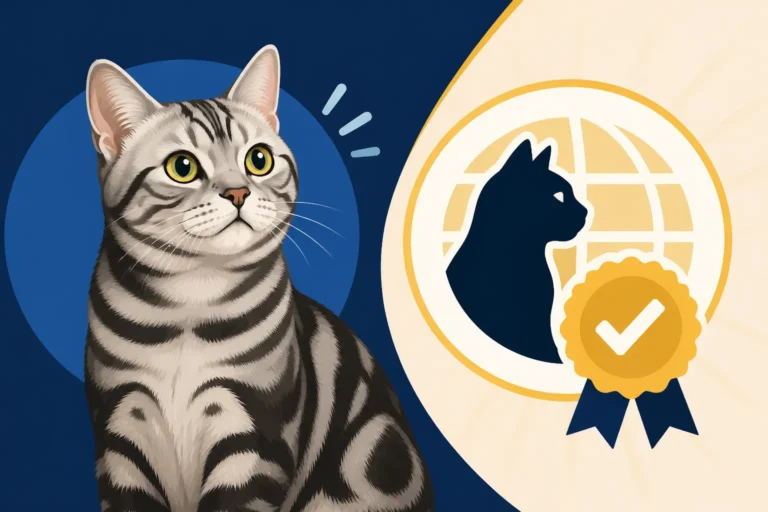
What Year the CFA That Registered the American Shorthair Began
The date is easy to muddle: the Cat Fanciers’ Association began in 1906, while the American Shorthair did not adopt its present name until 1966. Those dates mark different events. This guide explains what the CFA’s founding meant for the breed, how early registration language differed from today’s, and why a century-old registry still matters when people research American Shorthairs.
When the Cat Fanciers’ Association began
The CFA was founded in 1906
The Cat Fanciers’ Association, usually shortened to CFA, began in 1906. It was established to support organized cat breeding and exhibition in the United States, including keeping records of pedigreed cats and setting standards for recognized breeds. Its founding belongs to the early growth of formal cat shows and breed registries, when fanciers were trying to distinguish established types from cats described only by appearance.
That matters because a registry does more than keep a list of names. Registration links a cat to its recorded ancestry and to a recognized breed description. A breed standard, in turn, gives breeders and judges a shared reference for evaluating features such as body shape, coat, head, and overall balance. A registry cannot guarantee that every registered cat is healthy or that every breeder follows good practices, but it creates a framework for documenting pedigrees and judging cats consistently.
The CFA’s 1906 start is therefore the short answer to the question in this article’s title. It is also useful to separate the organization’s founding from later milestones in the American Shorthair’s history. The CFA began in 1906; the breed’s name changed decades later. For more about the recognition date specifically, see Which Year the CFA Recognized the American Shorthair.
The CFA’s early work reflected a changing cat fancy
In the early twentieth century, cat breeding and showing were becoming more organized. Clubs, breeders, and judges needed ways to identify cats, record ancestry, and agree on what a particular breed should look like. The CFA became part of that developing structure in the United States, bringing registration and exhibition into a more formal system.
The American Shorthair’s ancestors did not begin as carefully curated show cats. They were practical, short-coated cats valued for their ability to live alongside people and control rodents in farms, homes, and other working environments. As interest in showing cats grew, fanciers began to record and evaluate cats that represented this sturdy native type. The CFA’s early registry gave that process a place to take shape.
It is easy to picture a modern show cat when someone mentions a registry, but the early story is also about the transition from useful working cats to a defined pedigree breed. The CFA did not invent the cats themselves. Rather, its records and standards helped give a nameable, recognizable breed a formal place in the organized cat fancy. The breed’s working roots are explored further in Why the CFA Registered a Working Cat as the American Shorthair.
What early registration meant for the American Shorthair
The breed was first known by another name
The cats now called American Shorthairs were historically registered under the name Domestic Shorthair. That older label can confuse readers because today “domestic shorthair” is commonly used for shorthaired cats without a specific pedigree. In the early registry context, however, the term was associated with the breed that would later receive the American Shorthair name.
This difference between historical and everyday usage is important. A random-bred shorthaired cat may look similar to an American Shorthair, especially if it has a classic tabby coat and a sturdy build. Appearance alone does not establish pedigree. A registered American Shorthair has documented ancestry recognized under the relevant registry’s rules; a domestic shorthair is a broad description of coat length and type, not proof of a particular breed.
The terminology changed because breeders and fanciers wanted to make the pedigreed breed easier to distinguish from the much wider population of ordinary shorthaired cats. To trace how the older label fits into the breed’s history, read What the Breed Was Called Before American Shorthair and Why the American Shorthair Name Changed in 1966.
The 1966 name change was not the CFA’s founding
The 1966 name change and the CFA’s 1906 beginning are separate milestones, sixty years apart. The CFA was already an established organization long before the breed took its modern name. So, if you see both dates in breed histories, they are not competing answers to the same question: one refers to the organization’s founding, and the other refers to the breed’s renaming.
The new name helped clarify that the breed was a defined American pedigree breed, rather than simply any shorthaired cat living in the country. That distinction mattered to breeders, exhibitors, and prospective owners trying to understand what registration represented. It also helped preserve a consistent identity for the breed as cat shows and formal breed descriptions became more familiar to the public.
A brief timeline makes the distinctions easier to keep straight:
| Date or period | What it refers to | Why it matters |
|---|---|---|
| 1906 | The Cat Fanciers’ Association began | The organization’s early registry and show history began |
| Early CFA history | The breed was associated with the name Domestic Shorthair | The term referred to the developing pedigreed type in that historical context |
| 1966 | The breed adopted the name American Shorthair | The new name distinguished the pedigree breed from domestic shorthaired cats generally |
The breed did not suddenly appear in 1966, and the CFA did not begin that year. Instead, the cats had a longer history that was gradually formalized through breeding, registry records, and show standards. For the naming milestone itself, see What Year the Name Changed to American Shorthair.
Why a registry matters when you research the breed
Registration is about records, not a visual guess
A cat’s appearance can offer clues about its type, but it cannot prove that the cat is a registered American Shorthair. Many domestic shorthairs share familiar traits with the breed: a short coat, a broad body, strong-looking legs, or a tabby pattern. Those similarities do not establish ancestry. Pedigree records are the evidence that connects an individual cat to a registered line.
This distinction is especially helpful when looking at adoption listings or online advertisements. A shelter may reasonably describe a cat as an “American Shorthair type” if it resembles the breed, but that wording is not the same as a documented pedigree. If a seller claims a kitten is registered, ask which registry recorded it and request the relevant paperwork. A DNA test may estimate breed ancestry, but it does not replace the registry’s pedigree record.
CFA registration also should not be mistaken for a complete health guarantee. A registry records ancestry and breed status under its rules; it does not automatically mean that a particular cat has been screened for every health concern or raised in ideal conditions. Buyers should ask breeders about health history, veterinary care, and the parents’ records rather than treating a registration document as a substitute for those details. Which Five Breeds Founded the CFA With the American Shorthair offers more context on the organization’s early breed landscape.
Keep historical and current information in separate categories
When researching the American Shorthair, it helps to sort information into three buckets: the CFA’s history, the breed’s historical development, and a particular cat’s individual records. The CFA’s founding date belongs in the first bucket. The breed’s name change belongs in the second. A kitten’s registration, vaccination history, and health information belong in the third.
This separation prevents a common mix-up: assuming that an old organization date tells you when an individual cat was registered or when a breed standard took its present form. A registry’s rules and terminology can evolve. When you need details about a specific cat, consult the registry’s current records and the breeder or rescue that has the animal’s history.
For everyday ownership, keep practical records in one place: adoption or purchase documents, veterinary notes, microchip information, and any pedigree paperwork. If you use Chewy to order routine food or supplies, those purchases may help you keep track of household needs, but a retailer’s order history is not pedigree documentation. Chewy is not a cat registry, so a receipt or product profile cannot verify that a cat is an American Shorthair.
Common questions about the CFA and the American Shorthair
Did the American Shorthair begin in 1906?
No. The CFA began in 1906, but the cats that contributed to the American Shorthair type existed before that organization was founded. They were valued as practical, adaptable cats long before pedigree registries and show standards became central to their identity. The registry’s start marks a point in organized cat fancy history, not the origin of the cats themselves.
The breed’s story is better understood as a gradual shift. Cats with a useful shorthaired working type lived in North America; fanciers later began recording and showing cats that fit a more defined standard; and the breed eventually received the American Shorthair name. The CFA contributed to that formal process, but did not create the underlying population.
If you are reading an old account, pay attention to the date and vocabulary. A source that uses “Domestic Shorthair” may be discussing the pedigreed breed under its earlier name, or it may be using the term in the broader modern sense. Context is what tells you which meaning is intended.
Does CFA history help when choosing an American Shorthair?
It can help you understand what “registered” means and why pedigree records matter, but it should not be the only factor in choosing a cat. A long-established registry does not guarantee that every breeder is responsible, and a cat without pedigree papers can still be a much-loved, healthy companion. The right question depends on what you are looking for: a documented pedigree, a particular breed type, or simply a good match for your home.
If you are considering a registered kitten, ask to see its paperwork and confirm that the information matches the breeder’s claims. Ask about the kitten’s parents, veterinary care, socialization, and the breeder’s approach to health. If you are adopting, focus on the cat’s known health and behavior, and treat breed labels as estimates unless records support them.
For people who mainly need everyday supplies rather than pedigree research, Chewy may be one place to browse food, litter, and other cat-care products. But shopping information and breed-history information answer different questions. A retailer’s listing can help you compare products; it cannot tell you when the CFA began or establish a cat’s registered ancestry.
What should you remember about the dates?
Remember the simple distinction: the CFA began in 1906, while the American Shorthair name was adopted in 1966. The first date belongs to the organization. The second belongs to the breed’s naming history. Keeping those facts separate makes it much easier to read breed timelines without mistaking the registry’s founding for the breed’s origin.
The CFA’s history provides a useful window into how cat breeds became formally recorded and shown in the United States. The American Shorthair, in particular, reflects a transition from a practical working type to a recognized pedigree breed with a defined name and standard. That change did not erase its past; it gave the breed a clearer identity within the organized cat fancy.
If you are caring for an American Shorthair today, Chewy may be useful for routine shopping, while a breeder, rescue, veterinarian, or registry is the appropriate place to ask about records and individual care history. Each source serves a different purpose. Knowing that difference helps you avoid confusing a product listing, a breed resemblance, and formal pedigree documentation.
Disclaimer
This article is for general informational purposes only and does not constitute professional advice. Laws, prices and regulations vary by location and change over time. Consult a qualified professional for guidance on your specific situation.