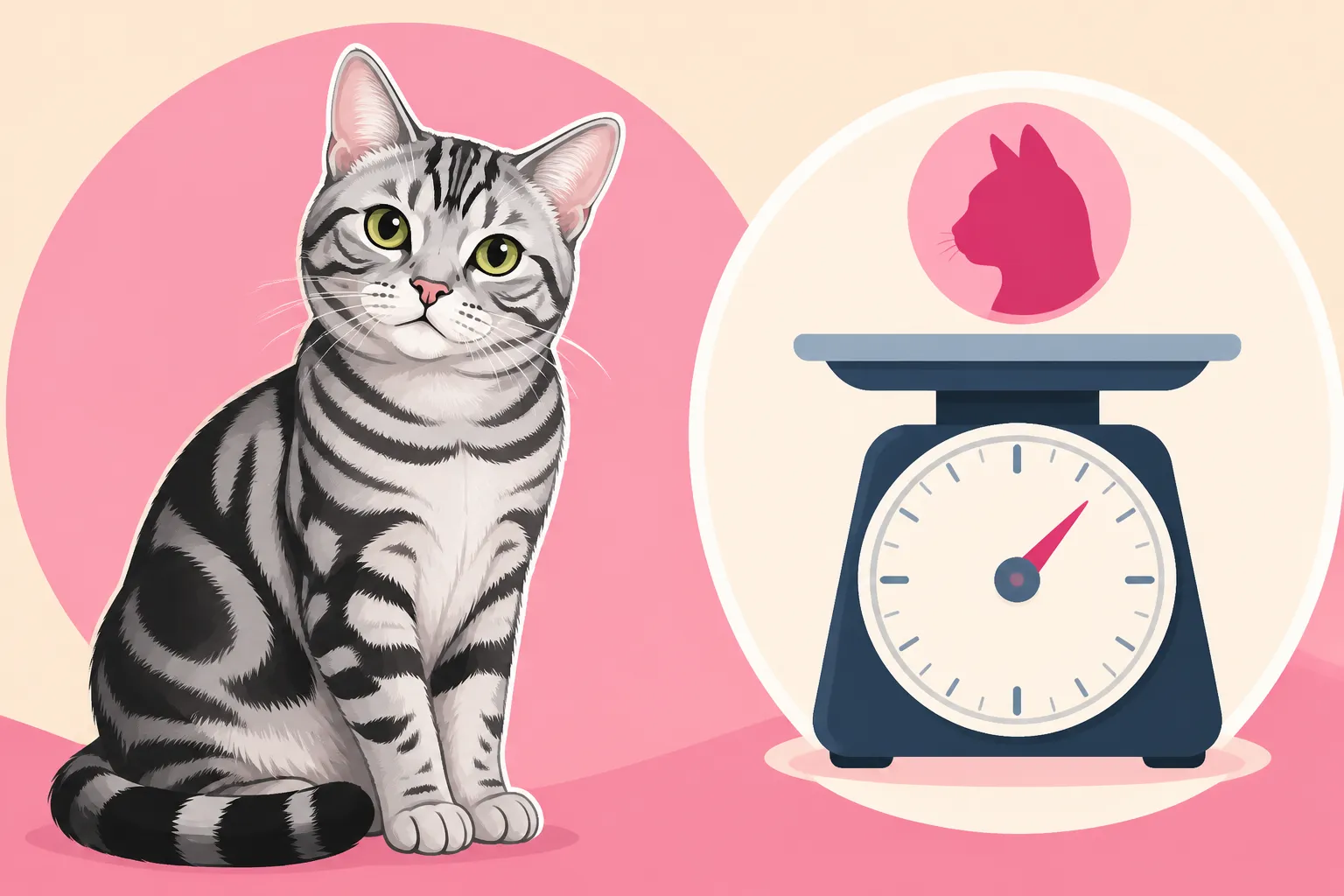
How Much a Female American Shorthair Weighs
A female American Shorthair commonly weighs about 8 to 12 pounds, but that range is a rough guide—not a pass-or-fail test. A broad chest, sturdy frame, age, and body condition all affect what a healthy weight looks like. This guide explains how to judge your cat’s size, weigh her at home, and recognize when a change deserves attention.
Typical weight for a female American Shorthair
Most adult female American Shorthairs fall somewhere around 8 to 12 pounds. Some healthy cats may be a little lighter or heavier, depending on their build. Breed averages can help you get oriented, but they cannot tell you whether one individual cat is at her best weight.
American Shorthairs are solid, muscular cats with a broad chest and a substantial frame. That build can make a healthy cat look heavier than a more lightly built cat of the same weight. For a useful overview of the breed’s typical range, see What an American Shorthair Weighs.
Why the number on the scale is only a starting point
Imagine two adult female American Shorthairs, each weighing 10 pounds. One has a visible waist when viewed from above, and you can feel her ribs under a light layer of fat. The other has no discernible waist, and her ribs are difficult to feel. The scale reads the same, but their body condition is different.
Weight is one measurement; body condition is about how that weight is distributed. Muscle, bone structure, and body fat all contribute to the total. A cat who is larger-framed may be healthy at a weight that would be too high for a smaller, fine-boned cat. A small cat may be overweight even if she falls inside a commonly quoted breed range.
That is why a vet’s assessment is more useful than an internet chart alone. At an appointment, your vet can consider your cat’s body condition, muscle tone, age, and medical history together. If she is doing well at a weight outside the typical range, that does not automatically mean something is wrong.
Why females are often smaller than males
Female American Shorthairs are generally smaller than males, though there is plenty of individual variation. A female may have a compact frame and weigh less than a male from the same breed without being underweight. The difference is a general pattern, not a rule that determines the ideal weight for every cat.
Some of the most noticeable changes happen as a young cat matures. An American Shorthair can continue filling out after she has stopped looking like a kitten, and her adult proportions may take time to settle. Read When an American Shorthair Reaches Full Size for more on that gradual development. The female-specific discussion in Why a Female American Shorthair Finishes Smaller can also help explain why comparing her directly with a male may give you the wrong impression.
Age matters in the other direction, too. An older cat might lose muscle while her overall weight changes very little. That can make a simple scale reading reassuring when her body is actually changing. Keep an eye on her shape and strength as well as her number.
What counts as a healthy weight for your cat
A helpful first step is to ask your vet to record your cat’s weight and body condition during a routine visit. If she appears healthy, that visit gives you a useful reference point for checking future changes. If she is already above or below her preferred condition, your vet can help establish a realistic goal for her individual frame.
You can also ask your vet to show you how to assess her body condition at home. A practical guide is How to Score a Square Built American Shorthair's Body Condition. The aim is not to make every cat look identical. You are learning to notice whether her waist, ribs, abdomen, and muscle tone are changing over time.
A cat’s weight should be interpreted alongside what is normal for her. If your American Shorthair has been active and comfortable at a stable weight for years, a sudden shift deserves more attention than a small difference from a breed average. Changes in appetite, thirst, energy, grooming, or litter-box habits can make a weight change more concerning.
How to tell whether your American Shorthair is carrying extra weight
Because the breed is naturally sturdy, it can be hard to tell where a solid build ends and excess fat begins. A rounded outline by itself is not enough to diagnose overweight, and a stocky appearance does not mean a cat should automatically be put on a diet. Look at her shape and feel for changes instead of relying on photographs or a single number.
Check her shape from above and from the side
When your cat is standing, look down at her from above. Many cats at a suitable body condition have a slight narrowing behind the ribs before the hips. It may be subtle in a broad-bodied American Shorthair, so do not expect a dramatic hourglass shape.
Next, view her from the side. The abdomen may rise gently toward the hind legs, although age, posture, and individual anatomy can affect what you see. A belly that hangs low is not automatically fat; some cats have a normal abdominal pouch. What matters is whether her waist and abdominal outline have changed along with other signs.
Run your hands gently along her sides. You should generally be able to feel the ribs with light pressure without having to press deeply. They should not be sharply prominent, either. For a practical hands-on check, see How to Find the Ribs on a Square Built American Shorthair. If you are unsure what you are feeling through her coat, ask your vet to demonstrate during a check-up.
Look for gradual changes, not just an obvious gain
Weight gain often happens quietly. A cat who gains a little over many months may still seem like herself: she eats, sleeps in her usual spots, and greets you at the door. Meanwhile, jumping onto a favorite chair may become less frequent, grooming her back may take more effort, or she may tire sooner during play.
A change in the way clothes fit is not the issue here, of course; it is the way her body shape changes from one month to the next. Keep simple records instead. A date, weight, and short note—such as “ribs easy to feel” or “less interested in climbing”—can make gradual changes easier to spot and explain to your vet.
If you notice a steady increase, do not sharply reduce her food on your own. Cats need a controlled plan, and sudden restriction can be dangerous. A vet can check for contributing health issues and work out an appropriate approach. The guide How a Vet Builds an American Shorthair's Weight Loss Plan covers the kind of structured support that may be useful if weight loss is needed.
When a weight change needs a vet’s attention
A noticeable change without an obvious explanation is worth discussing with a veterinarian. A cat who is losing weight despite eating well, gaining weight quickly, or showing a change in appetite should not simply be put on a different food and watched for months. Changes in thirst, vomiting, diarrhea, energy, or behavior are useful details to mention.
The speed and context of a change matter. A small shift after a move, a change in household routine, or a different feeding arrangement may have a straightforward explanation, but it is still worth tracking. A larger or continuing change, especially alongside other symptoms, calls for professional advice.
Keep in mind that American Shorthairs can be stoic. A cat may hide discomfort and continue behaving normally until a problem has progressed. If her weight changes and she also seems less active, withdrawn, or reluctant to jump, share those observations with your vet rather than assuming she is simply getting older.
How to weigh a female American Shorthair at home
Regular home weigh-ins can help you notice trends between vet visits. The process does not need to be elaborate. What matters most is using a reasonably consistent method, weighing her under similar conditions, and recording the result rather than reacting to every tiny fluctuation.
Choose a weighing method you can repeat
If your cat will sit still, a pet or baby scale can give a direct reading. Check that its platform is large enough for her to stand or sit comfortably and that its capacity suits her size. When comparing scales from general retailers or pet retailers such as Chewy, look at the platform dimensions and how the display handles small changes—not just the product name.
If she will not settle on a scale, you can weigh yourself while holding her, then weigh yourself alone and subtract the second reading from the first. This method is less precise, especially if she wriggles or the household scale rounds its readings, but it can still help you follow a broad trend. Using the same scale and technique each time makes comparisons more meaningful.
A third option is to ask your veterinary clinic whether you can bring her in for a quick weigh-in between appointments. That can be easier if she is nervous at home or if your household scale is not reliable. If you use a clinic, write down the date and the displayed weight so you can compare it with previous readings.
Make weigh-ins calm and consistent
Pick a time when your cat is relaxed, such as before a meal or after a nap. Set the scale on a stable, level surface and give her a moment to explore it. A familiar towel can make the surface less slippery, but if you use one, remember that it adds weight; either include it in every reading or tare the scale before placing her on it.
If she resists, do not turn weighing into a chase around the kitchen. Try again later, reward calm cooperation, and keep the session brief. A small treat can help, but include treats in her overall food allowance. If you use a food scale or portioning tools, retailers such as Chewy may offer options to compare; choose equipment that makes everyday measuring easier rather than adding unnecessary complexity.
Record the result with the date and any useful context. For example, note if the reading followed a change in food or a recent illness. A simple log is usually more useful than frequent, stressful attempts to capture an ultra-precise number. For a step-by-step home weighing approach, see How to Weigh an American Shorthair at Home.
A practical monitoring table
| What you notice | What it may mean | A sensible next step |
|---|---|---|
| Weight stays stable and ribs are easy to feel | Her current condition may suit her frame | Keep monitoring and discuss her target at a routine visit |
| Gradual gain and a less visible waist | She may be accumulating extra body fat | Track weight and ask your vet to assess her condition |
| Weight falls without a planned diet | A health or feeding issue may be involved | Contact your vet, especially if other symptoms appear |
| Weight changes with increased thirst or appetite | A change in health may need checking | Arrange veterinary advice rather than changing food alone |
| Scale readings vary widely from one attempt to another | The method may be inconsistent or stressful | Use a stable scale or ask the clinic to weigh her |
The table is a guide for deciding what to observe, not a way to diagnose a condition. If a result worries you, or your cat seems unwell, contact your veterinarian.
Feeding and weight changes through adulthood
A healthy weight is easier to maintain when food portions match your cat’s needs and her daily activity. American Shorthairs are sturdy, but indoor life can mean far less movement than their ancestors’ working routines. A bowl left available all day may make it difficult to know how much she has eaten, particularly in a home with multiple pets.
Measure food and account for the whole day
Start by checking the feeding directions on the food packaging, then treat them as a starting point rather than a personalized prescription. The right portion depends on factors such as age, activity, reproductive status, body condition, and the food’s calorie density. Your vet can help adjust the amount if your cat is gaining or losing weight.
Measure the portion with a consistent tool rather than estimating by eye. A scoop filled differently from one meal to the next can gradually add up. If you offer treats, account for them too; a few small extras may be easy to overlook when different people in the household feed the cat.
In a multi-cat home, feed cats separately if one steals from the other’s bowl. That makes it easier to know who ate what and can prevent the slower eater from being left with less than intended. If you change foods, transition gradually and watch how your cat responds rather than changing several parts of her routine at once.
Adjust expectations after neutering or a change in routine
Some cats need fewer calories after neutering, while activity levels and appetite can also shift with age or changes in the home. This does not mean every neutered female will gain weight. It does mean that a portion that suited her at one stage may need review later. The article Why a Neutered American Shorthair Needs Less Food explores why feeding needs can change.
A move from a large home to a smaller apartment, a new work schedule, or reduced playtime can also affect how much energy your cat uses. If her routine changes, keep the meal portions consistent at first and monitor her weight and body shape. Add manageable play sessions if she is willing, but do not assume exercise alone will resolve weight gain.
For food planning, use your veterinarian’s advice and the food label together. If you browse products or feeding accessories through retailers such as Chewy, check serving guidance and package details carefully, then confirm any diet changes with your vet when your cat has a medical condition or needs to lose weight.
Avoid quick fixes for weight loss
A cat who needs to lose weight should do so gradually under veterinary guidance. Cutting food dramatically can put her health at risk, and a cat who stops eating needs prompt veterinary attention. Do not use a dog’s diet food, leftover medication, or an online calorie target as a substitute for a plan made for your cat.
Ask your vet what the goal is, how to measure meals, and when to check progress. Regular follow-up makes it possible to adjust the plan if your cat is losing too quickly, not losing at all, or becoming less active. It also gives you a chance to discuss whether a health problem may be influencing her weight.
The most useful target is not a number copied from another cat. It is a weight and body condition that fit your female American Shorthair’s own frame and support comfortable movement, grooming, and play. A consistent record, a gentle hands-on check, and your vet’s guidance will tell you much more than the scale alone.
Disclaimer
This article is for general informational purposes only and does not constitute professional advice. Laws, prices and regulations vary by location and change over time. Consult a qualified professional for guidance on your specific situation.