Whether Papers Are the Only Difference an American Shorthair Has
A silver tabby with a broad face can look unmistakably like an American Shorthair, but appearance alone cannot establish its breed. That leaves many people wondering whether registration papers are just paperwork or evidence of a real distinction. This guide explains what papers show, what they cannot promise, how pedigreed American Shorthairs differ from domestic shorthairs, and what to check before choosing a cat.
What American Shorthair papers actually mean
Papers document ancestry, not just appearance
An American Shorthair is a pedigreed breed: its ancestry is recorded through a recognized cat registry, and breeders select cats according to a defined breed standard. Registration documents connect a particular cat to recorded parents and earlier generations. They are evidence of documented lineage, not a certificate saying that the cat simply looks the part.
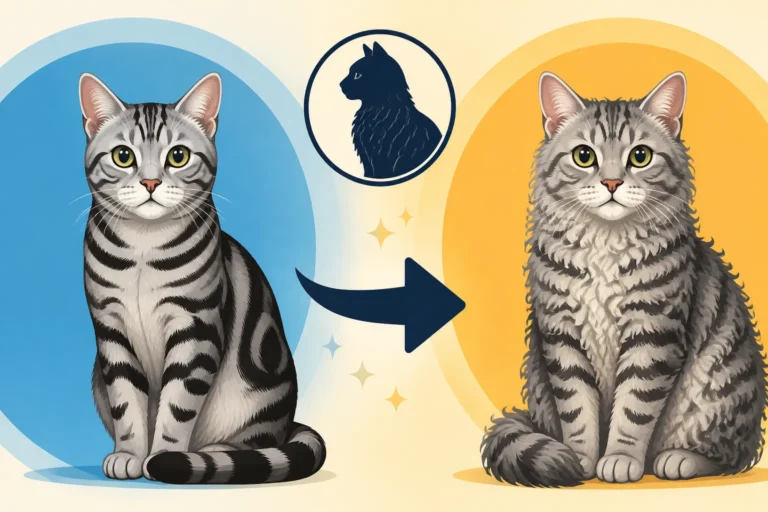
That distinction matters because many cats share features associated with the breed. A domestic shorthair might have a sturdy frame, rounded face, dense coat, or silver tabby markings. Those traits can make it look very much like an American Shorthair, but looks do not create a documented pedigree. The difference between breed identity and resemblance is explored in How an American Shorthair Differs From a Domestic Shorthair and What a Domestic Shorthair Is Next to an American Shorthair.
If someone advertises a cat as an American Shorthair but cannot explain its recorded lineage or provide registration details, treat the breed claim as unverified. That does not mean the cat is unhealthy, undesirable, or less deserving of a home. It means the seller has not shown that the cat is a registered American Shorthair.
Papers do not guarantee a particular personality or health outcome
Registration papers tell you about ancestry. They do not promise that a cat will be affectionate, easygoing, sociable with children, or happy to sit on your lap. Individual temperament is shaped by many influences, including the cat’s inherited traits, early handling, environment, and experiences. Even littermates can have noticeably different personalities.
Nor do papers automatically confirm that a cat has had every relevant health check. A pedigree may help you trace a cat’s family, but it is not the same thing as veterinary records, screening results, or a health guarantee. Ask what examinations and tests were completed, who performed them, and whether you can review the records. What an American Shorthair Pedigree Guarantees explains the limits of what a pedigree can establish.
The same caution applies to a breeder’s description of a cat as “healthy lines.” Ask for specific records rather than relying on a general assurance. For an American Shorthair, it is reasonable to ask what health information is available for the parents and whether the breeder can share relevant screening results. A useful related checklist is Which Health Results an American Shorthair Breeder Must Show.
The paperwork should be traceable and understandable
If a breeder says papers are included, ask which registry issued them, what the documents will show, and whether you will receive the registration information for your specific kitten. The details can vary by registry and breeder arrangement, so do not assume that every document labeled “papers” means the same thing. Ask for the registry name and an explanation of how the kitten’s identity connects to its recorded parents.
You should also check that the paperwork matches the cat. Names, dates, identifying details, and parent information should make sense together. If documents are pending, ask what remains to be completed and when the breeder expects to provide them. A clear answer is more reassuring than a vague promise that everything is “registered somewhere.”
If you are adopting from a shelter or rescue, the cat may have little or no family history. That is common and does not make the cat less suitable as a companion. It simply means you should describe the cat as a domestic shorthair or an American Shorthair-type cat unless reliable pedigree documentation supports the more specific breed claim.
How a pedigreed American Shorthair differs from a look-alike
Breed traits are patterns, not a visual test
The American Shorthair standard describes a sturdy, balanced cat with a strong build and a short, dense coat. Breeders work toward those characteristics over generations, so registered cats tend to share recognizable features. But a standard describes a breed ideal; it is not a checklist that lets anyone identify every cat with certainty.
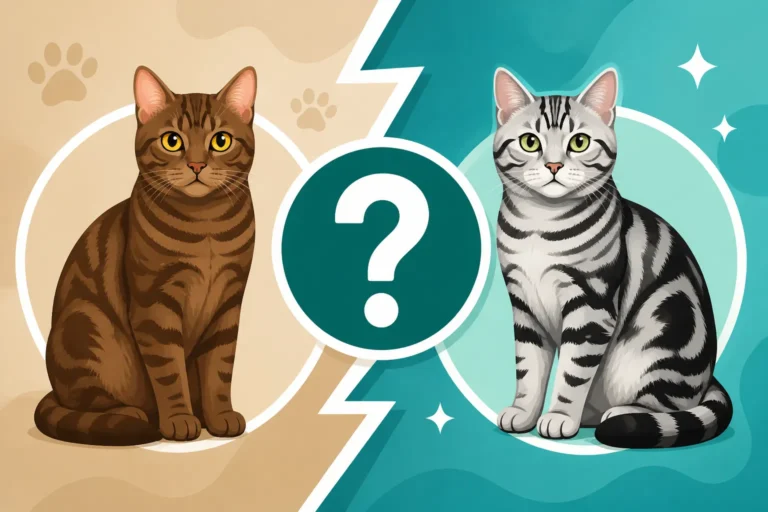
A domestic shorthair can also be muscular, round-faced, and short-coated. A tabby pattern, including the familiar silver tabby look, is not proof of American Shorthair ancestry. Coat color and pattern can help describe a cat, but they do not establish its pedigree. For a closer look at the visual overlap, see How to Tell an American Shorthair From a Random Bred Tabby.
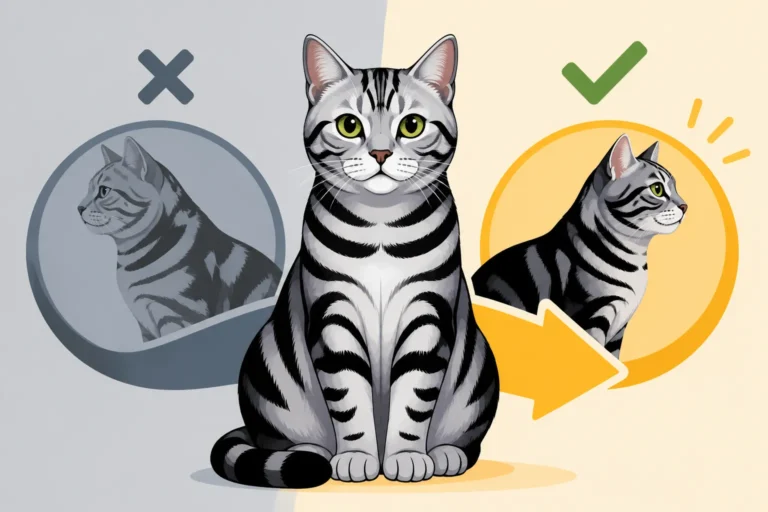
This is why a photo-based guess can be misleading. A cat from a shelter may look strikingly similar to a show-quality American Shorthair, while a pedigreed cat may not match the image someone has in mind. Appearance may raise a question about breed, but documented lineage is what supports a pedigree claim.
A domestic shorthair is not a lesser version of the breed
“Domestic shorthair” is a broad description for a short-coated cat without a verified pedigree for a particular recognized breed. It does not mean the cat has a known mix of specific breeds, and it does not mean the cat is a failed or incomplete American Shorthair. Many domestic shorthairs are healthy, charming cats whose ancestry is simply undocumented.
The distinction is similar to the difference between knowing a cat’s family history and making an educated guess from its appearance. A domestic shorthair may share some physical traits with an American Shorthair, but those similarities do not establish that it descends from registered American Shorthair lines.
A cat also does not become a pedigreed American Shorthair just because it resembles one or because someone believes it has the right temperament. If you are wondering whether a cat can be reclassified later, Whether a Domestic Shorthair Can Become an American Shorthair addresses why appearance alone cannot supply missing ancestry records.
| What you are checking | Pedigreed American Shorthair | Domestic shorthair |
|---|---|---|
| Breed status | Supported by recorded ancestry and registry documentation | No verified pedigree for a specific breed |
| Appearance | Often reflects the breed standard, though individuals vary | Can resemble an American Shorthair or many other types |
| Family history | May be traceable through registration records | Often unknown or incomplete |
| Personality | Influenced by the individual cat, upbringing, and environment | Also varies from cat to cat |
| Health information | Papers alone do not prove health; ask for medical and screening records | Health history depends on what the shelter, rescue, or previous owner knows |
| Value as a companion | Depends on the match between cat and household, not paperwork alone | Equally capable of being a wonderful companion |
DNA results are not a substitute for pedigree records
People sometimes turn to a DNA test hoping it will settle the question. Genetic tests can provide information about ancestry or inherited traits, depending on the test, but they do not replace a documented pedigree from a recognized registry. A result that suggests some similarity to a breed is not the same as proof that a cat is a registered American Shorthair.
This is especially important for mixed or random-bred cats, whose ancestry may include many generations of cats without recorded breed status. A test can offer clues, but its results should not be treated as a definitive breed certificate. Whether a DNA Test Tells an American Shorthair From a Moggy goes into that distinction in more detail.
If the main question is whether a breeder’s kitten is pedigreed, ask for registry documentation and a clear account of its lineage. If the question is simply what kind of cat you have at home, a DNA test may be interesting, but it is not necessary to appreciate the cat in front of you.
How to assess a breed claim before you commit
Ask direct questions and look for clear answers
Whether you are speaking with a breeder, a rescue, or a private seller, ask how the cat’s breed is known. If the answer is that the cat “looks just like” an American Shorthair, that describes appearance, not pedigree. If the cat is registered, ask to see the relevant documents and learn which registry recorded the lineage.
It is also fair to ask whether the cat’s parents are registered and what health information is available. A responsible breeder should be willing to explain the documents and distinguish registration from health screening. If you feel rushed or are told that records are unnecessary, pause before making a decision. A good match should not depend on pressure or a label that cannot be supported.
For a quick comparison, consider these practical questions:
- Is there a named registry and documentation for this particular cat?
- Can the seller explain the cat’s parentage and show how the records connect?
- Are medical history and health screening records available separately?
- Is the breed claim based on documents, or mainly on appearance?
- If papers are unavailable, is the cat being described honestly as an American Shorthair-type cat or domestic shorthair?
Separate breed paperwork from care planning
Once a cat comes home, its daily needs are not determined by its papers alone. You will still need to plan for veterinary care, safe transport, food, water, litter, scratching surfaces, and a gradual introduction to the household. A shelter cat with unknown ancestry and a registered American Shorthair both deserve thoughtful care based on their individual age, health, and behavior.
For practical shopping, make a list before browsing so you do not end up buying gear that does not fit your home or your cat. A retailer such as Chewy can be one place to compare basics like carriers, litter boxes, and food, but your veterinarian is the right person to advise on a diet for a cat with a medical need. Check the carrier dimensions against your cat’s build rather than assuming a standard size will be comfortable.
If the cat’s history is uncertain, bring any available adoption or medical records to the first veterinary visit and ask what information is still useful to establish. Chewy may also be convenient for replenishing routine supplies once you know what your cat accepts, but a cat’s health records should come from the clinic or the organization that cared for it—not from a product listing or a breed label.
Choose the cat, not just the documents
Papers can be important if you specifically want a pedigreed American Shorthair, hope to show or breed the cat, or value a documented family history. In that case, verify the paperwork and ask about health records before committing. If your priority is a companion, a cat’s individual temperament, care needs, and fit with your household may matter more than whether its ancestry is recorded.
That distinction can make the search less frustrating. A shelter cat that resembles an American Shorthair is not secretly a pedigreed cat just because it has the familiar build, and a pedigreed cat is not automatically the right fit for every home. A reputable source should be straightforward about what is known and what is not.
Before the cat arrives, plan for the practical details that are easy to overlook: a quiet settling-in room, a suitable litter box, food the cat can transition to gradually, and a carrier that feels secure. Chewy is one possible source for everyday supplies, while your shelter, breeder, or veterinarian can help clarify what the cat is already used to. In the end, papers answer a question about ancestry; they do not measure how much a particular cat will mean to you.
Disclaimer
This article is for general informational purposes only and does not constitute professional advice. Laws, prices and regulations vary by location and change over time. Consult a qualified professional for guidance on your specific situation.