What an American Shorthair’s Tail Should Look Like
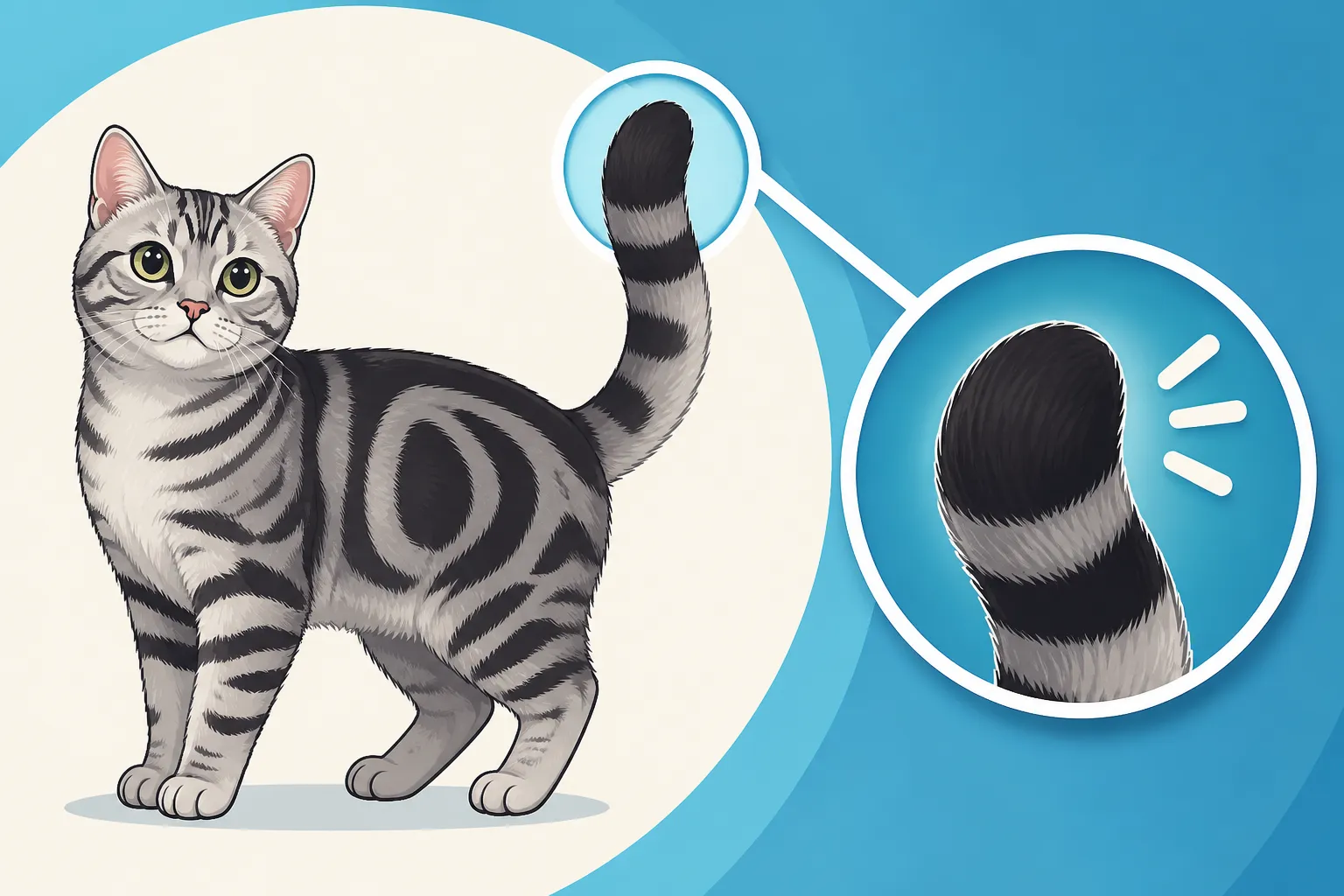
An American Shorthair’s tail should look balanced with its sturdy body: broad at the base, gradually tapering, and ending in a rounded tip. But a tail that looks different from a show ideal isn’t automatically a health problem, and a sudden change deserves more attention than a lifelong quirk. This guide explains what to look for, what can vary, and when to call a veterinarian.
The American Shorthair tail standard
Shape and proportion
The American Shorthair is a medium-to-large, muscular cat with a strong, balanced outline. Its tail is meant to fit that outline rather than look especially long, short, delicate, or dramatic. The breed standard describes a tail that is substantial at the base, tapers toward the end, and finishes in a rounded tip.
“Proportionate” is useful here. The tail should look like it belongs to the cat’s overall build: neither so long and fine that it seems mismatched with the cat’s solid frame, nor so short or thick that it appears blunt. The breed’s sturdy appearance is also reflected in features such as its head, legs, and body. For more about the overall outline, see What an American Shorthair Looks Like by the Standard.
A tail can look different depending on whether the cat is standing, walking, curled up, or holding it upright. Fur can also make the outline seem fuller or narrower. When judging the shape, look at the tail from a few angles while the cat is relaxed, rather than deciding from one photograph taken in an unusual pose.
What the tip should look like
A typical American Shorthair tail narrows gradually toward a rounded end. The tip should not look sharply pointed, squarely cut off, or unusually knobby. Still, a naturally rounded tip can be hard to judge through dense fur, especially when the cat is sitting with its tail tucked close to its body.
It helps to think in terms of the whole shape instead of fixating on the last fraction of an inch. A smooth taper is more characteristic than an abrupt change from a thick tail to a very thin one. A little variation between cats is normal, and a pet cat does not need to match a show winner in every detail to be a much-loved, healthy companion.
If the tail’s outline has always looked the same and the cat moves it comfortably, that is generally different from a new bend, swelling, wound, or change in how the cat carries it. A sudden difference is worth paying attention to even if the tail does not match the breed description perfectly.
Breed ideal and individual variation
A written standard describes the desired type for a breed; it is not a diagnosis or a promise that every individual cat will look exactly alike. A tail may be somewhat longer or shorter than the ideal, or may appear more substantial because of the cat’s coat and build. Those differences alone do not establish that the cat is sick or injured.
The wider body matters, too. American Shorthairs develop a solid frame, and their proportions change as they mature. A young cat may not yet have the same filled-out appearance as an adult. For context on how the breed’s size develops, see How Big an American Shorthair Gets.
It is also worth separating breed identity from appearance. Many domestic shorthairs have a similar build or tabby pattern, and looking at a tail alone cannot prove that a cat is a pedigreed American Shorthair. If you are comparing breed type, How an American Shorthair Differs From a Domestic Shorthair and What a Domestic Shorthair Is Next to an American Shorthair explain why paperwork and ancestry matter alongside looks.
How to tell normal variation from a concern
Lifelong quirks versus sudden changes
The most useful question is often not “Does this tail look exactly right?” but “Has it always looked this way?” A tail that has had a slight bend, unusual carriage, or distinctive shape for the cat’s entire life may simply be an individual feature. A new change—especially after a fall, a door accident, a fight, or rough handling—needs more careful attention.
Cats can hide discomfort, so behavior may provide clues. A cat that suddenly avoids having its back end touched, stops lifting or moving its tail normally, or becomes unusually withdrawn may be in pain. You might also notice that the tail hangs lower than usual, looks swollen, or is held at an unfamiliar angle.
Do not try to straighten a tail or test how far it bends. If the cat seems uncomfortable, give it a quiet place to rest and contact a veterinarian for advice. Handling an injured tail can increase pain, and a cat that is frightened may scratch or bite even if it is normally easygoing.
Signs that warrant veterinary attention
Seek veterinary guidance if the tail has a fresh wound, bleeding, marked swelling, an obvious new bend, or an area that feels unusually warm. A tail that is limp or difficult for the cat to move is also a reason to get advice promptly, particularly if there was a known accident. If the cat cannot urinate or defecate normally after a tail or back-end injury, treat that as urgent and contact a veterinary clinic right away.
A change in sensation can be difficult for an owner to assess safely. Don’t pinch the tail or tug on it to see whether the cat reacts. Instead, observe whether the cat moves the tail voluntarily, whether the position has changed, and whether there are other signs such as hiding, reduced appetite, or difficulty walking.
Some signs may be subtle. A cat that suddenly stops jumping onto a familiar chair or objects to being picked up may be uncomfortable even if there is no visible wound. Describe what you have noticed and when it began. A clear timeline can help your veterinarian assess whether the issue may be related to an injury or another problem.
When tail position is part of communication
A healthy tail does not stay in one position. Cats raise, lower, curve, flick, and wrap their tails for different reasons. An upright tail can appear when a cat is greeting someone; a tail held close to the body may occur when the cat is resting or feeling cautious. A quick flick can mean the cat is alert or becoming irritated, but tail signals should be read alongside the rest of its body language.
There is no single position that proves a cat is happy, angry, or unwell. Look at the ears, posture, facial expression, and situation as well. For example, a cat watching birds through a window may hold its tail very differently from the same cat greeting you at the front door.
A change in usual behavior matters more than an isolated pose. If your cat’s tail is suddenly held low throughout the day, or it reacts painfully when the tail is approached, that is more meaningful than a brief flick during play. If you want to understand the breed’s overall outline and common judging considerations, Which Faults Judges Mark on an American Shorthair puts tail shape in the context of the whole cat.
Tail appearance in kittens, adults, and show cats
How a kitten’s tail changes as it grows
Kittens are not miniature versions of fully developed adults. Their proportions can look uneven as they grow, and their bodies continue to fill out over time. A kitten with a tail that seems slightly long or fine compared with its body may look more balanced as its frame matures.
Coat can affect what you see, too. As the coat changes from kitten softness to the denser adult coat, the tail may appear fuller or more defined. Photos taken during different stages can make the same tail look quite different, so compare them with care.
If the tail seems to be developing a sudden bend, if the kitten reacts painfully to touch, or if its movement changes, check with a veterinarian instead of assuming it is a harmless growth phase. Normal development does not explain a painful new change.
What a show description does and does not mean
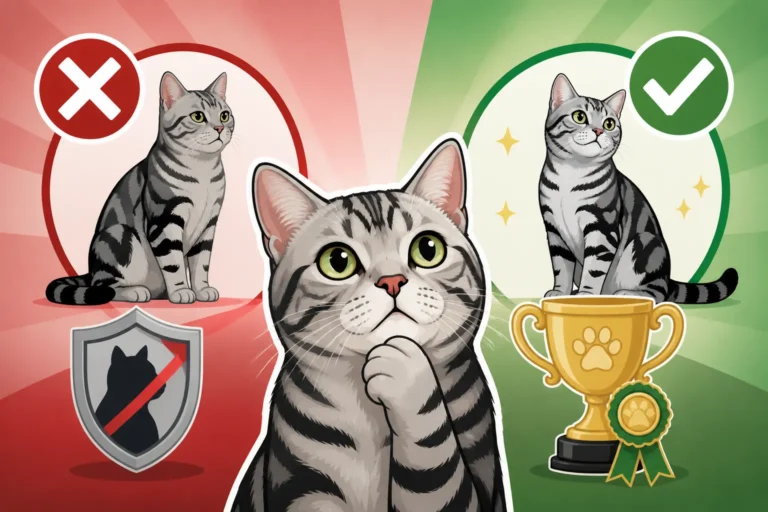
A breed standard is mainly a guide to the desired physical type in the show ring. Judges assess the cat as a whole, including its proportions, structure, coat, and condition. A tail that departs from the preferred shape may affect how closely a show cat matches the standard, but that is not the same thing as saying the cat has a medical problem.
Likewise, a cat that looks like an American Shorthair is not necessarily registered as one. Registration depends on pedigree and the rules of a recognized registry, not just a convincing tail, coat, or body shape. Whether a Pet American Shorthair Can Be Shown explores how show eligibility differs from simply having the breed’s general appearance.
For someone choosing a companion, the show ideal should not become a source of unnecessary worry. A healthy, comfortable cat with a tail that is a little outside the preferred outline can still have all the qualities that make people love American Shorthairs: a sturdy build, an expressive presence, and a practical short coat.
Taking useful photos for comparison
If you are unsure whether your cat’s tail has changed, photos can help you describe what you see. Take a few ordinary pictures in good light: one from the side while the cat stands naturally, one from behind if the cat is comfortable, and one showing the tail in its usual resting position. Do not force the tail into a pose or hold the cat still for a photo.
Keep the images dated so you can compare them later. A single image may make a tail look crooked because the cat is twisting, the fur is flattened, or the camera is at an angle. Several relaxed views are more useful than a close-up of the tip alone.
If a photo shows a new injury or the cat seems painful, don’t delay veterinary advice while trying to build a perfect record. For routine home care, select supplies that support safe play and movement. A properly sized carrier or sturdy climbing furniture can be found through pet retailers such as Chewy, but an injured cat should not be encouraged to climb or play until a veterinarian advises that it is safe.
Everyday care that protects the tail
Make the home easier to navigate
A tail can be bumped or caught in ordinary household situations: a closing door, a reclining chair, a crowded hallway, or a playful collision with another pet. You cannot remove every risk, but noticing where your cat squeezes through or rests can help you make the space safer. Check that doors and furniture move without trapping the cat’s tail, and give the cat room to pass without having to push between heavy objects.
Cats also need play that lets them move naturally rather than being grabbed or chased. Wand toys can encourage a cat to stalk and pounce without hands becoming the target. Retailers such as Chewy carry many kinds of cat toys, but choose based on your cat’s play style and supervise toys with strings or small detachable pieces.
If children live with the cat, show them how to let the cat approach and how to pet gently along areas the cat accepts. Pulling or holding the tail is never an appropriate way to handle a cat. A calm retreat area gives the cat a way to leave when it has had enough interaction.
Keep an eye on changes during routine care
You do not need to repeatedly manipulate your cat’s tail to monitor it. Instead, notice its usual shape and movement during ordinary activities: walking across the room, stretching, or greeting you. A quick visual check during grooming is generally enough to spot obvious dirt, a wound, or a change in how the tail is carried.
If your cat’s coat makes it hard to see the tail clearly, use a soft brush and let the cat set the pace. Chewy is one place owners may look for basic grooming supplies, but brushing should be gentle and should stop if the cat objects or seems sore. Tail care should not turn into a struggle.
For a cat that is difficult to handle, don’t force an examination at home. A veterinarian can advise on safe handling and whether the cat needs to be examined. The goal is to notice meaningful changes without creating stress or causing discomfort.
Focus on comfort, not cosmetic perfection
The breed description gives a useful picture of the American Shorthair’s balanced tail: substantial at the base, gradually tapered, and rounded at the end. It is a reference point, not a reason to measure a beloved cat against a show-ring checklist. A lifelong quirk is not automatically a problem; sudden changes, pain, or impaired movement deserve attention.
When choosing a cat or learning more about the breed, consider the whole animal rather than one feature. Body shape, temperament, history, and health all matter. What People Get Wrong About the American Shorthair addresses some common assumptions that come from judging a cat by appearance alone.
If you are setting up a home for an active cat, consider safe places to rest and climb, along with toys that encourage movement without rough handling. Chewy and other pet retailers can be options for supplies such as cat furniture or interactive toys; choose items that suit your home and your cat, rather than assuming any product will prevent injury. A relaxed, comfortable cat is a better guide than a perfect-looking silhouette.
Disclaimer
This article is for general informational purposes only and does not constitute professional advice. Laws, prices and regulations vary by location and change over time. Consult a qualified professional for guidance on your specific situation.