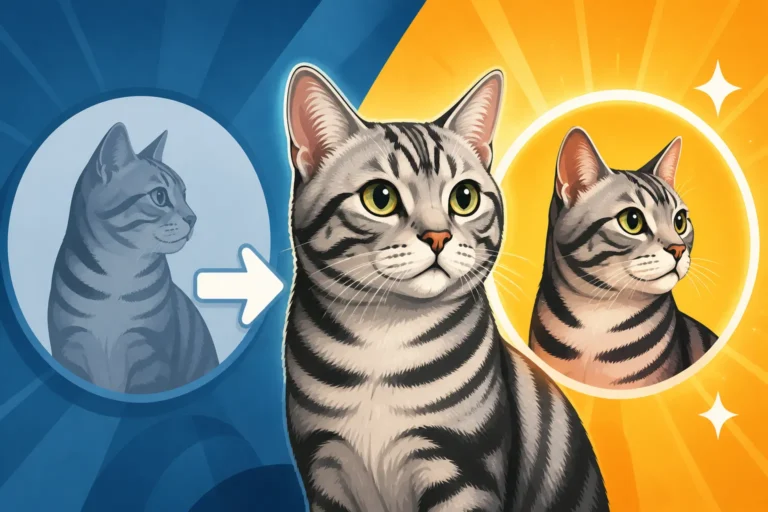
Whether the American Shorthair Standard Rewards Extremes
A cat-show standard can sound as if it prizes a huge head, an extra-heavy body, or some other exaggerated feature—but that is not the American Shorthair’s goal. The breed is meant to look sturdy and balanced, not extreme. This guide explains what the standard rewards, what judges may penalize, and how to distinguish a sound, substantial cat from one whose features have been pushed too far.
What the American Shorthair standard is designed to reward
A capable, balanced cat rather than an exaggerated one
The American Shorthair was developed from practical working cats, and its standard reflects that history. The ideal cat is strong and substantial, with a body that suggests it could move effectively and do physical work. That does not mean the cat should look oversized, heavy to the point of clumsiness, or built around one showy feature. The overall impression matters: the parts should fit together.
A standard is a written description of the desired type for a breed. It gives judges a common framework for assessing a cat, but it is not a recipe for maximizing every trait. A broad chest, for example, should make sense with the cat’s body and legs. A rounded head should remain proportionate to the body. Strength is part of the look; exaggeration is not the same thing as strength.
This distinction matters because “substantial” can be misunderstood. A well-built American Shorthair may look solid beside a lighter-framed cat, but the ideal is still an athletic, balanced animal rather than a barrel-shaped one. The standard is about coherent structure, not simply weight or bulk. For a closer look at the written ideal, see What the American Shorthair Standard Asks For.
The whole cat counts more than one striking feature
A cat with an unusually broad head or especially heavy body may catch the eye at first. But a judge assesses the whole animal: head, body, legs, tail, coat, condition, and the way those features work together. If one feature dominates so much that the cat looks unbalanced, it may detract from the overall impression rather than improve it.
That is why a photo can be misleading. A close-up may make the head look enormous, while the body is out of frame. A low camera angle can make a cat appear shorter and more massive. Coat condition, pose, and grooming can also change how a cat reads in a picture. In person, proportion and movement provide context that a tightly cropped image cannot.
The standard is therefore best understood as a guide to type, not a contest to produce the most extreme version of a feature. The ideal American Shorthair should look like a sturdy, functional cat from more than one angle. What an American Shorthair Looks Like by the Standard offers useful context for how those traits are considered together.
Which features can look exaggerated
Head shape, muzzle, and eyes
The breed’s head is meant to be rounded and developed, with a muzzle that contributes to a strong expression. Those qualities can be pushed visually: a very broad head, very full cheeks, or a muzzle that seems oversized for the rest of the face may create a more exaggerated appearance. But a bigger-looking feature is not automatically a better example of the breed.
Proportion is the key. The head should relate naturally to the neck and body, and the muzzle should look integrated rather than abruptly prominent. Eyes, ears, and facial contours also contribute to the expression. If one element overwhelms the others, the cat may look less balanced even if that feature is individually striking.
It can help to compare the cat’s outline rather than fixating on a single detail. Does the head seem to belong to the body? Do the facial features create a harmonious expression? Does the cat look sturdy without appearing coarse or distorted? Those questions are more useful than asking whether one feature is “as large as possible.” For a discussion of potential consequences, see Whether an Extreme American Shorthair Head Would Bring Problems.
Body, legs, and coat
The American Shorthair is a muscular, solid breed, but a sound body should still allow the cat to move comfortably. A very heavy appearance is not proof of ideal structure; body fat can obscure the underlying frame and make it difficult to assess muscle and proportion. A cat’s condition should not be confused with breed type.
Legs and feet also need to look appropriate to the body. If the body appears so massive that the legs seem unable to support it gracefully, the overall impression may be less functional. Similarly, a dense coat can make a cat look larger or rounder than it is. Looking at the cat standing and moving can help separate coat volume from body shape.
This is one reason the standard’s emphasis on balance matters beyond the show ring. A square, sturdy outline is different from a cat whose size or condition makes everyday movement difficult. Owners choosing supplies should focus on the individual cat’s actual dimensions and comfort, not just the breed label. When browsing carriers at Chewy, for example, measure the cat and check the usable interior space rather than assuming a product marked for a particular breed will fit.
| Feature | Balanced interpretation | Possible sign of exaggeration |
|---|---|---|
| Head | Rounded and in proportion to the body | Appears oversized or dominates the cat’s outline |
| Muzzle | Strong and integrated with the face | Looks disproportionately broad or prominent |
| Body | Muscular and substantial, with a coherent outline | Appears bulky, poorly balanced, or heavy from excess weight |
| Legs | Appropriate to the body and able to support natural movement | Seem too short or slight for the body’s apparent mass |
| Coat | Dense and healthy without obscuring the cat’s shape | Fluff or grooming makes the cat appear much larger than its frame |
How show judging and breed standards work
A standard is a framework, not a promise of perfect uniformity
Breed standards describe an ideal, but real cats vary. Two well-bred American Shorthairs may not look identical, and judges must assess individual animals rather than compare them with a single photographic template. A written standard helps organize that assessment, but it does not erase natural variation or guarantee that every judge will emphasize each detail in exactly the same way.
Standards can also differ between registries. Their wording and judging systems are not necessarily identical, so a description from one organization should not automatically be treated as the definitive rule for every show. Breeders and exhibitors usually work with the registry whose rules apply to their cats and competitions.
The standard is not intended to reward every feature taken to an extreme. Judges look for the desired breed type and consider faults or departures from it. The idea is to recognize a cat that fits the description well overall—not simply the cat with the most dramatic head, heaviest frame, or boldest coat. To understand how written descriptions can evolve, see Whether the American Shorthair Standard Has Changed.
Breed type is not the same as an individual cat’s needs
A show standard describes appearance and type; it does not tell an owner exactly how much food, exercise, or equipment an individual cat needs. Even within a sturdy breed, one cat may be larger-framed than another, and two cats of similar size can have different activity levels. Care should be based on the cat in front of you, not on an assumption that every American Shorthair has the same build or appetite.
For example, a cat may look broad and solid but still be at a healthy weight, while another may carry excess fat that makes its outline look more exaggerated. A veterinarian can help assess body condition and advise on feeding. If you use portioning tools or compare feeding products at Chewy, treat the label as a starting point; adjust feeding with veterinary guidance rather than relying on breed stereotypes.
Nor should a show-ring ideal be mistaken for a health diagnosis. A striking appearance alone does not prove that a cat is unhealthy, and a cat that does not perfectly match the ideal is not automatically in poor condition. The more useful questions are whether the cat can move comfortably, maintain a healthy body condition, and receive appropriate routine care.
What prospective owners should take from the standard
Look for soundness and proportion, not a caricature
If you are considering an American Shorthair, use the standard to understand the breed’s general appearance, but do not choose a cat simply because it looks like the most dramatic show photograph. Look at the animal as a whole. Does its body appear balanced? Does it move freely? Does its expression and structure look natural rather than overstated?
Ask a breeder how they think about type, health, and the qualities they aim to preserve. A responsible conversation should not be limited to color or head shape. It should include the cat’s welfare, the parents’ health, and how the breeder evaluates the kittens as they grow. You can also read What People Get Wrong About the American Shorthair for common assumptions that blur the line between breed identity and appearance.
If a cat is already part of your family, there is no need to compare it constantly with show standards. Standards are useful for describing a breed, not for ranking a pet’s worth. A mixed-breed cat or an American Shorthair that does not match every show detail can still be a healthy, much-loved companion.
Ask whether selection supports welfare
A breed standard can help preserve a recognizable type, but how people use it matters. If breeders focus narrowly on extreme features, they may put appearance ahead of sound structure or comfortable movement. If they value proportion, temperament, and health alongside appearance, the standard can instead support a functional, recognizable cat.
When discussing a kitten, ask what traits the breeder values and how they avoid overemphasizing a single feature. Ask what health information is available and whether you can meet the kitten’s mother or see where the cats are raised. Pay attention to whether the breeder speaks about the animals as individuals, not merely as examples of a look.
For owners, the practical lesson is straightforward: the American Shorthair ideal is substantial but not exaggerated. A sturdy frame, rounded features, and a strong expression belong together in a balanced cat. If you need supplies, choose them by your cat’s measurements and behavior. A scratcher or bed listed at Chewy may be marketed for a certain type of cat, but your cat’s actual size, preferences, and comfort are what matter. For broader discussion of breed standards and welfare, see Whether Welfare Bodies Have Anything to Say About the American Shorthair.
Disclaimer
This article is for general informational purposes only and does not constitute professional advice. Laws, prices and regulations vary by location and change over time. Consult a qualified professional for guidance on your specific situation.