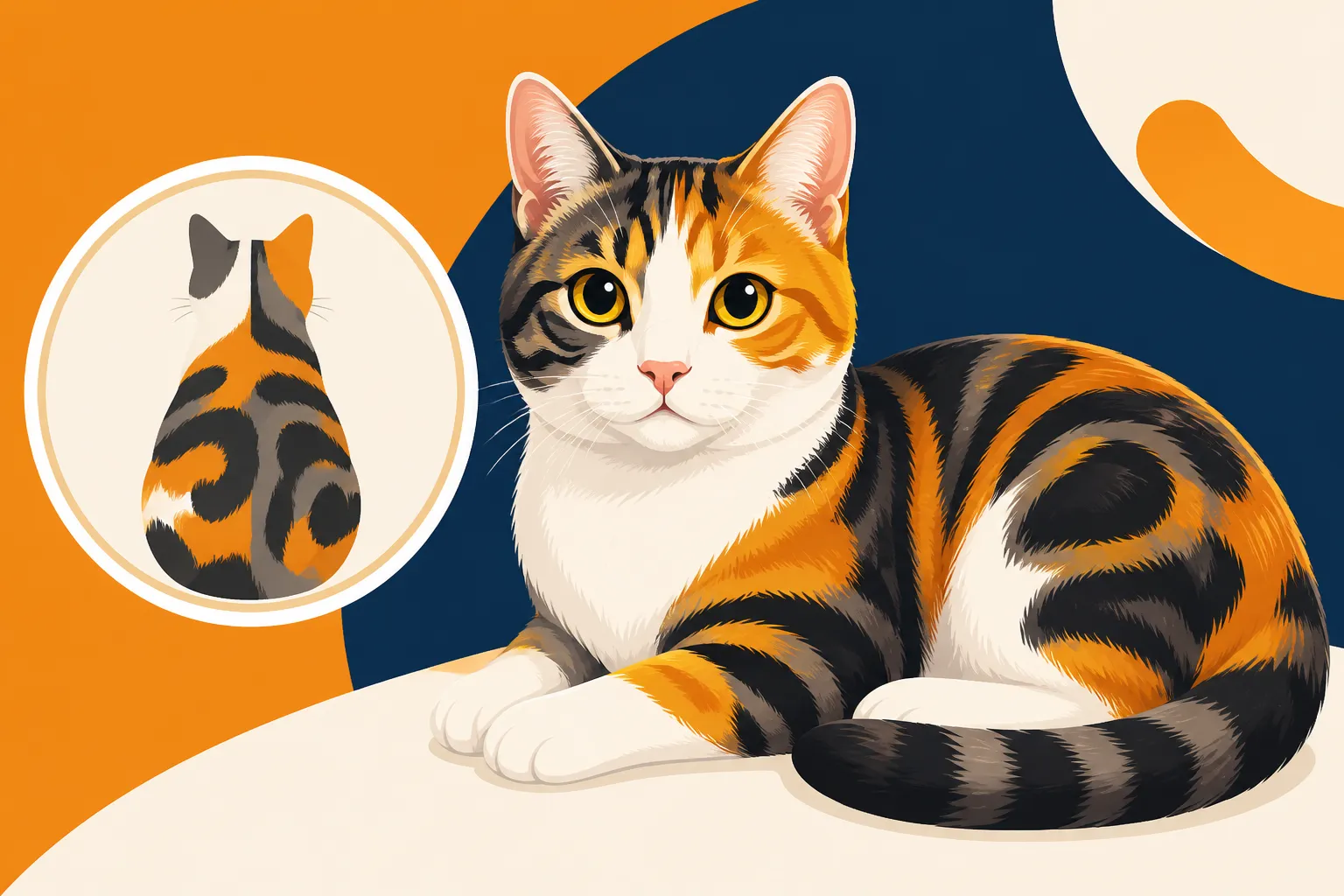
What a Calico American Shorthair Is
A cat with white, black, and orange patches may look like an obvious calico, but that coat pattern does not prove the cat is an American Shorthair. This guide explains what “calico American Shorthair” means, how the pattern differs from tortoiseshell coloring, what genetics can tell you, and how to confirm whether a cat is actually a pedigreed American Shorthair.
What a calico American Shorthair is
Calico describes the coat, not the breed
A calico American Shorthair is an American Shorthair with a calico coat pattern. “American Shorthair” names the breed; “calico” describes the arrangement of colors on the coat. The distinction matters because many domestic cats can be calico, and a calico appearance by itself cannot establish a cat’s breed.
A typical calico has three visible colors: white, black, and orange or red. The patches may be large and clearly separated, or smaller and more unevenly distributed. In a dilute calico, the darker colors appear softened, often as blue-gray and cream, alongside white. The exact look varies from cat to cat.
American Shorthairs are known for a sturdy, balanced build and a short, dense coat. Those features may help you compare a cat with the breed’s appearance, but they are not proof of pedigree. For a broader look at the breed’s build and proportions, see What an American Shorthair Looks Like by the Standard. To explore the range of accepted colors, see Which Colors an American Shorthair Comes In.
How calico differs from tortoiseshell
Calico and tortoiseshell coats can both combine black and orange coloring, so it is easy to mix them up. The clearest visual difference is usually the amount and placement of white. Calicos have noticeable white areas along with their other colors. Tortoiseshell cats generally have black and orange colors intermingled or patchy, with little or no white.
The line can look less tidy in real life than it does in a simple description. A cat’s patches may blend at the edges, and lighting can make dark fur look brown or gray. Some cats have a mostly white coat with a few colored patches; others have more black and orange covering the body. It is the overall combination of white, dark color, and orange or cream that makes the calico pattern recognizable.
A calico pattern is also different from a bicolor pattern, which generally means two colors rather than the typical three-color calico combination. If you are comparing coat descriptions, What a Bicolor American Shorthair Is explains that pattern in more detail. Breed registries may group colors and patterns in particular ways, so a breeder’s or registry’s terminology can be more precise than casual descriptions.
What the pattern cannot tell you
A calico coat does not reliably predict a cat’s personality, energy level, or affection style. It may be tempting to assume that a calico will be more spirited or independent, especially when that idea gets repeated among cat owners, but an individual cat’s behavior is shaped by many factors. Early socialization, health, environment, and the cat’s own temperament all matter.
That is true even when the cat is a pedigreed American Shorthair. Breed tendencies can offer a general impression of what to expect, but they are not a promise about any one animal. A kitten that is cautious around visitors may become more confident with time and gentle handling; an outgoing kitten may still prefer to sit beside you rather than be carried.
When choosing a cat, pay attention to the individual in front of you. Ask how the cat responds to everyday handling, household sounds, and familiar people. If you are adopting, a shelter or rescue may be able to describe the cat’s observed behavior, though its background may be incomplete. Coat color is a useful description, not a personality assessment.
Why most calico cats are female
The basic genetics behind the colors
The genes involved in orange and black coat coloring are linked to the X chromosome. Female cats typically have two X chromosomes, while male cats typically have one X and one Y chromosome. A female cat can inherit one version of the color gene associated with orange and another associated with black. As different cells switch off one of their X chromosomes during development, patches of orange and black can appear across the coat.
White areas come from a separate process involving white spotting. When white spotting combines with the orange-and-black patchwork, the result is the familiar calico appearance. This is why a calico is not simply a cat with three unrelated colors painted evenly over its coat: the colors emerge through a combination of inherited traits and how those traits are expressed as the cat develops.
The same broad genetic pattern applies whether the cat is an American Shorthair or another type of cat. Breed affects the cat’s overall appearance and lineage; the sex-linked color inheritance helps explain why the traditional calico combination is seen overwhelmingly in females.
Why a male calico is unusual
A male cat with a calico coat is unusual because the typical male chromosome pattern does not usually provide two X chromosomes for the orange-and-black patchwork to develop in the familiar way. Rare male calicos may have an atypical chromosome arrangement, such as XXY, or result from other uncommon genetic circumstances. Some cases involve mosaicism or chimerism, in which cells with different genetic makeups occur in one animal.
A male calico’s appearance does not automatically reveal which genetic explanation applies. If the question matters for health, breeding, or a veterinary assessment, a veterinarian can advise whether further evaluation is appropriate. Male calico cats with XXY chromosomes are often sterile, but an owner should not assume fertility or infertility from coat color alone.
This rarity also does not make a male calico more likely to be an American Shorthair. The pattern and the breed are separate questions. A male calico may be a domestic shorthair, a pedigreed cat, or a cat whose ancestry is unknown. As with any cat, pedigree documentation—not the unusualness of the coat—is what supports a breed claim.
What dilute calico means
A dilute calico has a softened version of the classic black-and-orange appearance. Black may appear blue-gray, and orange may appear cream. White remains part of the pattern. “Dilute” refers to the way pigment is expressed; it does not mean the cat is a different breed or that the coat is a sign of illness.
Color names can be confusing when a coat falls between familiar shades. A gray-looking patch may be described as blue in cat-color terminology, while a pale orange patch may be called cream. Photos can also shift a coat’s apparent color depending on daylight, indoor lighting, and camera settings. If color matters for a registration or show record, use the terminology required by the relevant registry rather than relying on a casual label.
How to tell an American Shorthair from a calico look-alike
Color is not proof of pedigree
A short-haired calico can resemble an American Shorthair without being one. Domestic shorthairs come in a broad range of colors and body shapes, including calico. The phrase “American Shorthair” refers to a recognized breed with documented ancestry; it is not simply a formal name for any short-haired cat born in the United States.
That distinction can be frustrating when a shelter listing describes a cat as an American Shorthair based on appearance. The cat may indeed look similar, and it may make a wonderful companion, but appearance alone cannot verify the breed. A registered pedigree and reliable records are more useful evidence than coat color, head shape, or a seller’s verbal assurance.
For a closer comparison, read How an American Shorthair Differs From a Domestic Shorthair and What a Domestic Shorthair Is Next to an American Shorthair. The practical takeaway is straightforward: a calico coat can help describe a cat, but it cannot certify its ancestry.
| What you are checking | What it can tell you | What it cannot prove |
|---|---|---|
| White, black, and orange patches | The cat likely has a calico pattern | That the cat is an American Shorthair |
| A sturdy body and short coat | The cat may resemble the breed’s general appearance | That the cat has a documented pedigree |
| Pedigree and registration records | Evidence of recorded breed ancestry | A guarantee of health or temperament |
| A DNA test marketed for breed ancestry | May offer ancestry estimates, depending on the test | A substitute for accepted pedigree documentation |
What paperwork to ask for
If you are buying a kitten represented as a pedigreed American Shorthair, ask to see the relevant registration and pedigree documents. Check that the kitten’s identifying information matches the paperwork, and ask which registry the breeder uses. A responsible breeder should be willing to explain how the kitten’s parentage is documented and what records will accompany the sale.
Paperwork is especially useful when a cat’s appearance seems convincing but the history is unclear. A calico’s coat may be striking, yet the same color pattern occurs in many unrelated cats. Whether Papers Are the Only Difference an American Shorthair Has offers more context on what documentation can and cannot establish. For shelter cats, Whether a Shelter Tabby Can Be Registered as an American Shorthair addresses why a familiar-looking coat does not necessarily qualify a cat for breed registration.
Do not let a photo or a coat-color label replace basic questions about the cat’s care and background. Ask about veterinary records, vaccinations, and any known health concerns. A pedigree can help document ancestry, but it does not guarantee that a cat will never develop a health problem or that its temperament will match a breed stereotype.
Eye color and other identifying details
Eye color can vary among American Shorthairs and is considered alongside coat color and other features in breed descriptions. It is not a dependable way to identify a calico or verify a breed. Two calico American Shorthairs can have different eye colors, and cats outside the breed can have similar eyes. For more on the range of colors, see Which Eye Colors an American Shorthair Has.
When looking at the whole cat, consider the head, body, coat, and documented history together rather than relying on one feature. American Shorthairs are generally described as muscular and substantial without being extreme in build. But kittens are still growing, adult cats differ naturally, and weight can change the way a body looks. A single snapshot rarely gives enough information to judge breed accurately.
Living with a calico American Shorthair
Grooming and everyday coat care
A calico American Shorthair does not need a special grooming routine because of its color pattern. The coat is short, but regular brushing can help remove loose hair and give you an easy chance to notice changes in the skin. Some cats shed more seasonally, while indoor cats may shed throughout the year. The cat’s individual coat and home environment matter more than whether the pattern is calico.
Keep grooming low-pressure. Let the cat sniff the brush, start with a brief session, and stop before it becomes irritated. This is often easier than waiting until there is a large amount of loose hair and trying to brush it all out at once. A comb or brush chosen for short coats is usually enough for routine maintenance; special grooming products are not required just because a cat is calico.
If you are comparing basic grooming tools on Chewy or another retailer’s site, focus on suitability for a short coat, ease of cleaning, and whether the cat tolerates the tool. Chewy listings may make it convenient to compare ordinary supplies, but product choice should not be confused with breed verification. For more on coat care, The American Shorthair's Coat Was Built for Weather, Not a Judge discusses the breed’s practical coat.
Feeding, play, and household routines
Calico coloring does not determine what a cat should eat. Choose food based on the cat’s age, body condition, health, and veterinary guidance. Measure meals rather than assuming that a sturdy-looking American Shorthair needs unlimited food. Indoor cats can gain weight when portions and treats exceed what their daily activity supports, and a healthy body condition is easier to maintain than to restore after substantial weight gain.
Play is useful for exercise and enrichment, regardless of coat color. Short interactive sessions with a wand toy or another safe toy can give a cat a chance to stalk, chase, and catch. Some cats prefer fast movement; others are more interested in a toy that pauses behind furniture or moves like prey. Let the cat’s response guide the activity rather than expecting a particular style because it is an American Shorthair.
When browsing food puzzles or enrichment supplies on Chewy, consider the cat’s eating habits and how easily the item can be cleaned. A puzzle feeder can make a meal more engaging, but it should not make food so difficult to reach that the cat gives up. A second mention of Chewy is simply a shopping reference; the important point is to choose an appropriate, safe item and introduce it gradually.
Choosing a cat for your household
If you are choosing between a calico American Shorthair kitten and an adult calico cat of uncertain ancestry, think about the qualities that matter in daily life. Do you want a documented pedigree, or are you primarily looking for a compatible companion? Are there children, other pets, or long stretches when the cat will be alone? The answers may matter more to your experience than the coat pattern.
Meet the cat if possible and ask how it behaves in familiar settings. With a breeder, ask about parentage, early socialization, and health records. With a shelter or rescue, ask what staff have observed and whether the cat has lived with other animals or children. In either setting, give the cat time to settle after moving. A newly arrived cat may hide or act reserved before its usual personality becomes clear.
If you need supplies before bringing the cat home, Chewy and other pet retailers can be places to compare basics such as a carrier, litter box, food dishes, and grooming tools. Check that items suit the cat’s size and needs, and ask the breeder, shelter, or veterinarian about familiar food and litter during the transition. A calm, predictable setup is more helpful than buying a large collection of novelty products.
Disclaimer
This article is for general informational purposes only and does not constitute professional advice. Laws, prices and regulations vary by location and change over time. Consult a qualified professional for guidance on your specific situation.