Whether the American Shorthair Had a Standard in 1906
The American Shorthair was not called the American Shorthair in 1906, which makes the breed’s early history easy to misread. It was recognized under the name Domestic Shorthair, but early recognition does not mean the modern breed standard already existed in its present form. This guide explains what 1906 recognition meant, what can and cannot be said about an early standard, and how the breed’s identity developed.
What the American Shorthair was called in 1906
The breed existed before it had its present name
In 1906, the cat now known as the American Shorthair was recognized under the name Domestic Shorthair. “American Shorthair” came later, after breeders wanted to distinguish the developing pedigree breed from the much broader population of ordinary shorthaired cats.
That distinction matters because the words Domestic Shorthair were used more broadly than a modern breed name usually is. A shorthaired cat could be described as domestic without belonging to a selectively bred, documented pedigree line. The old label therefore does not mean that every short-haired cat in America was an American Shorthair. It refers to the name under which the early breed was recognized.
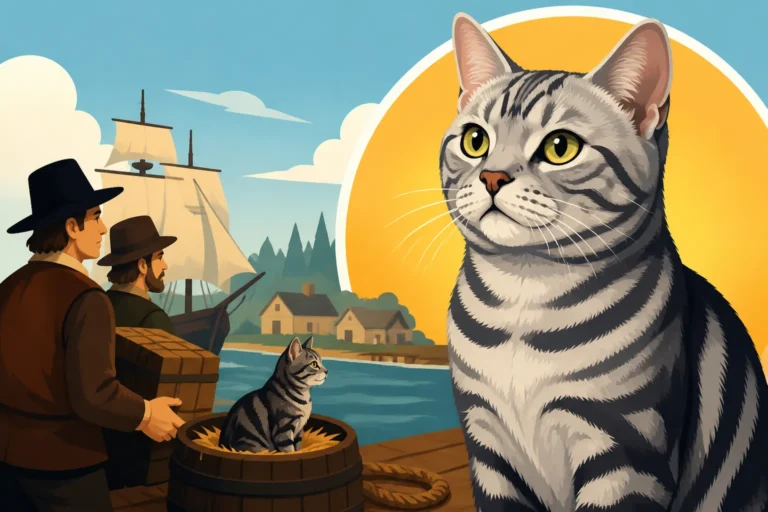
The breed’s working background also helps explain why its early identity was less tightly separated from everyday cats than it is now. Its ancestors were valued for practical qualities such as strength, a sturdy body, and the ability to live and work around farms, homes, and ships. They were not initially developed to look like a highly specialized show cat. For more on that working history, see How Farm Work Shaped the American Shorthair.
Early recognition and a modern pedigree breed are not identical
A breed’s recognition is a formal step: a registry accepts it as a category and sets out criteria for identifying and evaluating cats in that category. But recognition in 1906 should not be read as proof that the breed already had the exact name, detailed pedigree system, or visual definition it has today.
It is more accurate to think of the early Domestic Shorthair as a starting point in the American Shorthair’s formal history. A named breed can develop gradually: breeders agree on a type, registries record cats, and written descriptions become more specific over time. The present-day breed is the result of that process, rather than a finished modern standard appearing all at once in 1906.
The distinction is similar to the difference between a family’s long-standing local tradition and a written rulebook adopted later. The underlying type may have been there, but the way it was described, recorded, and judged could become more precise as organized breeding took hold. The early registration story is explored further in Which Year the CFA Recognized the American Shorthair.
Did the American Shorthair have a standard in 1906
The careful answer is yes in an early sense, not as the modern standard
The breed’s formal history reaches back to 1906, when it was recognized under the Domestic Shorthair name. That supports saying there was an early breed category and a basis for describing the cats in it. But it would be misleading to claim that the full American Shorthair standard used today was already in place, unchanged, under the name American Shorthair.
A standard is not simply a date on a registry record. It is a written description of the qualities a breed should have, and it can be refined as breeders and judges define the desired type more clearly. Early descriptions may have emphasized a practical, balanced cat, while later standards set out more exact expectations for features such as head shape, body, coat, and proportions.
So if you are asking, “Was there an American Shorthair standard in 1906?” the most useful answer is: there was early recognition of the breed’s predecessor as Domestic Shorthair, but the modern American Shorthair standard should not be projected backward as though it were already complete. For a closer look at the early written description, see How the First American Shorthair Standard Read.
Why a registry record does not tell the whole story
It is tempting to treat “recognized in 1906” and “had today’s standard in 1906” as interchangeable. They are not. Recognition tells us that a registry accepted a category. To know what cats were expected to look like at that moment, we would need the relevant written standard and a clear understanding of how it was applied.
A registry’s early records can also reflect a different approach to breed identity than modern pedigree practice. The cats may have been recorded under a broad name, while the later American Shorthair came to represent a more defined type. The history is therefore not a simple before-and-after switch from “no breed” to “finished breed.” It is a gradual process of naming, documenting, and narrowing the description.
| Historical detail | What it tells us | What it does not prove |
|---|---|---|
| Recognition in 1906 under Domestic Shorthair | The breed’s formal registry history began early | That the current name was already in use |
| A recognized category | Cats could be recorded and evaluated within a defined group | That every shorthaired cat belonged to that breed |
| Written descriptions or standards | Breeders and judges had criteria to work with | That the criteria were identical to today’s |
| The later name American Shorthair | The breed’s identity became more distinct | That the breed itself began only when the name changed |
This careful distinction avoids two opposite mistakes: saying the breed had no formal history until it received its modern name, or claiming its present-day standard was already settled in 1906.
How the breed’s standard and identity changed
From Domestic Shorthair to American Shorthair
The old name created a practical problem. “Domestic Shorthair” could describe a wide range of shorthaired cats, including cats without pedigrees. As organized breeding developed, a broad label became less useful for distinguishing a particular breed with a consistent type and documented lineage.
The name American Shorthair helped make that distinction. It gave breeders, registries, and cat owners a clearer way to refer to the established breed rather than to shorthaired cats generally. The change was about more than wording: it helped reinforce the idea that the breed had a recognizable identity of its own. See What the Breed Was Called Before American Shorthair and Why the American Shorthair Name Changed in 1966.
That history also explains why an ordinary tabby can look a great deal like an American Shorthair without being one. Appearance alone does not establish pedigree. A domestic shorthair may share the breed’s sturdy build or tabby pattern, but a registered American Shorthair is identified through breeding records and the applicable registry requirements. The distinction is covered in How an American Shorthair Differs From a Domestic Shorthair.
The standard describes a chosen type, not every cat’s history
A breed standard is a guide to the preferred characteristics of a breed. It does not mean that every cat in the breed looks identical, nor does it erase the breed’s working origins. Instead, it gives breeders and judges a shared description of the type they are trying to preserve.
For the American Shorthair, the standard has helped define a balanced, sturdy cat rather than a deliberately extreme shape. A square-looking, muscular body and a coat suited to ordinary life fit the breed’s practical heritage, but the written criteria help translate a general impression into details that can be assessed consistently. The current standard’s development is not the same thing as the broader history of the cats themselves.
Standards can also change over time. They may be clarified or adjusted as a registry’s understanding of the breed becomes more precise. That is why it is useful to ask not only whether a standard existed, but also which version, under what name, and for which registry. For more on that evolution, see Whether the American Shorthair Standard Has Changed.
How to interpret the 1906 date
Use the date as a starting point, not a claim that everything was settled
The year 1906 is useful because it marks an early formal chapter in the breed’s registry history. It tells you that the cats now associated with the American Shorthair were being recognized long before the modern name became standard. It does not mean that the contemporary breed description, show culture, and pedigree practices all appeared fully formed in that year.
When you see a claim that the American Shorthair was recognized in 1906, it is reasonable to ask a few follow-up questions:
- Was the cat or breed recorded under the name American Shorthair, or under an earlier name?
- Does the claim refer to registry recognition, a written standard, or both?
- Is it describing the first version of a standard or the current one?
- Which registry’s rules and records are being discussed?
Those questions help keep breed histories accurate. They also explain why two sources can appear to disagree while describing different parts of the same timeline. One may be talking about early recognition, while another is referring to the later name or a subsequent standard.
Why the distinction matters to cat owners
For someone choosing a pet, the historical date does not tell you whether a particular cat is healthy, well socialized, or a good fit for your home. Nor does a cat’s resemblance to the breed prove that it has American Shorthair ancestry. If pedigree matters to you, ask for the relevant registration and family records rather than relying on coat pattern or body shape alone.
For someone interested in breed history, the distinction prevents a different kind of confusion: treating the American Shorthair as either a brand-new breed created in 1966 or a fully defined modern breed that was unchanged in 1906. Its story sits between those extremes. The cats and their practical type came first; formal recognition, a clearer name, and an increasingly specific standard helped shape the breed people recognize today.
The most defensible conclusion is that the American Shorthair’s formal roots reach back to 1906 under the Domestic Shorthair name. There was an early recognized category, but it should not be confused with the modern American Shorthair standard or assumed to have been identical to later versions. That combination of early history and gradual definition is what makes the date meaningful.
Disclaimer
This article is for general informational purposes only and does not constitute professional advice. Laws, prices and regulations vary by location and change over time. Consult a qualified professional for guidance on your specific situation.