Whether a White American Shorthair Goes Deaf
A white American Shorthair is not automatically deaf, but a white coat—especially alongside blue eyes—can be a clue worth discussing with your veterinarian. The connection comes from feline genetics, not from the breed being uniquely prone to hearing loss. This guide explains what appearance can and cannot tell you, how deafness is confirmed, and how to keep a deaf cat safe and comfortable.
Why some white cats are born deaf
The link between white fur, blue eyes, and hearing
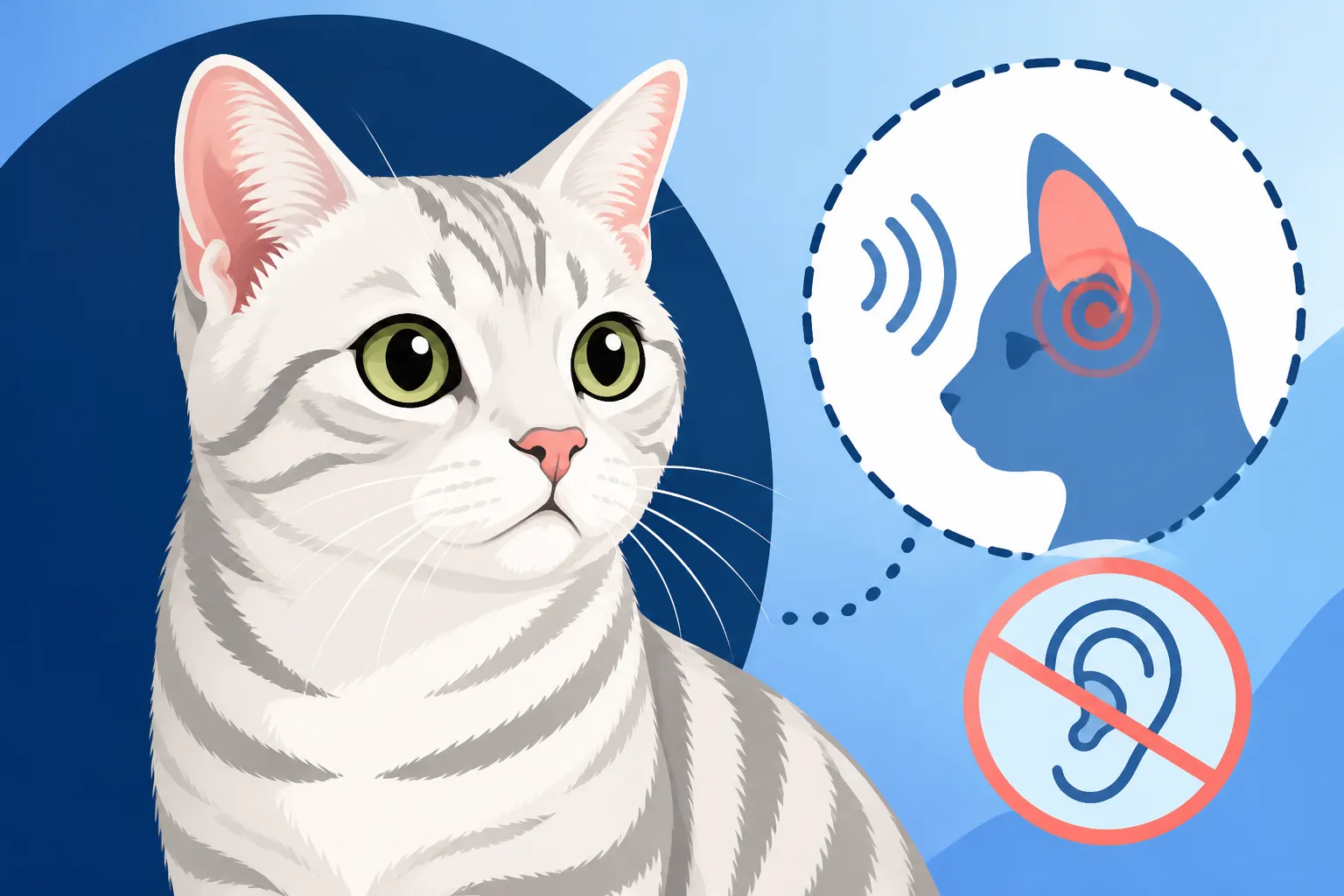
In cats, genes that produce a white coat can affect the development of pigment-producing cells. Those cells also play a role in the normal development of structures in the inner ear. When the relevant cells do not develop or function as they should, congenital deafness can result.
That connection does not mean every white cat is deaf. Many white cats hear normally, and a cat’s coat color cannot diagnose a hearing problem. The possibility is more concerning when a cat has blue eyes, but blue eyes are still not proof of deafness. A white cat with one blue eye and one eye of another color may be deaf in one ear, both ears, or neither.
This is a general feline pattern, not a known trait that makes the American Shorthair uniquely susceptible. A white American Shorthair should be considered in the same way as any other white cat: appearance may raise a question, but a hearing test is what can answer it. For more context on the breed’s range of eye colors, see Which Eye Colors an American Shorthair Has and Which Eye Color Goes With Each American Shorthair Color.
Coat color does not confirm pedigree or hearing status
A white coat alone also cannot establish that a cat is a pedigree American Shorthair. Domestic shorthairs come in white, too, and cats that look similar can have different ancestry. If you are trying to understand whether a cat is an American Shorthair, appearance and hearing ability are separate questions. How to Tell an American Shorthair From a Random Bred Tabby explains why looks alone can be misleading.
It is also easy to confuse a white coat with albinism. A white cat is not necessarily albino; coat color, eye color, and the genes that influence them can vary. Nor does a white coat necessarily mean the cat has a vision problem. If you are evaluating a kitten or adult cat, focus on observable health and behavior rather than assuming a diagnosis from its coloring.
Odd-eyed cats can prompt extra questions because one eye may be blue while the other is not. That pattern does not tell you which ear can hear, or whether either ear is affected. Whether an Odd Eyed American Shorthair Exists offers breed-specific background on that appearance, but a veterinary hearing assessment remains the practical way to check an individual cat.
How to tell whether an American Shorthair may have hearing loss
Behaviors that can raise a concern
A deaf cat may sleep through noises that wake other cats, fail to turn toward a sound, or seem unaware when someone enters a room. Some cats do not react to a vacuum, a door closing, or a familiar voice. Others may vocalize more loudly than expected because they cannot hear their own voice clearly.
These observations are clues, not reliable home tests. A cat might ignore a sound because it is relaxed, focused, asleep, or simply uninterested. Testing by repeatedly shouting, clapping near the cat, or making startling noises can cause stress and still cannot show whether hearing loss affects one ear or both.
Pay attention to patterns instead. Does your cat respond to sounds when awake and facing away from you? Does it react to a familiar noise in one room but not another? Has its behavior changed recently? Write down what you notice and when. A short record is often more useful to your veterinarian than a single dramatic sound test.
For an older cat, a gradual reduction in response to sound may have a different explanation from deafness present since birth. How to Tell If an Old American Shorthair Has Gone Deaf discusses signs that can be mistaken for ordinary aging, while Why a Withdrawn American Shorthair Should See a Vet covers why a broader behavior change deserves attention.
What a veterinary hearing check can establish
A veterinarian can examine the ears and look for issues such as debris, inflammation, infection, or other changes that may affect hearing. They will also ask whether the problem seems lifelong or new, and whether it affects one or both sides. Some causes of hearing loss may be treatable, so it is worth having a new or worsening change checked rather than assuming it is simply age or coat color.
For a more objective assessment, a veterinarian may recommend a BAER test, short for brainstem auditory evoked response. The test measures the electrical response of the hearing pathway to sound and can assess each ear separately. That distinction matters: a cat that hears in one ear may behave quite differently from one that cannot hear at all.
A home observation cannot replace that assessment. Nor can a DNA result alone establish whether an individual cat is deaf. Breed ancestry, coat color, and hearing status are related only in limited ways; they are not interchangeable pieces of evidence. If a cat’s background is unclear, Whether a DNA Test Tells an American Shorthair From a Moggy explains why ancestry testing is not a shortcut to confirming breed identity—or diagnosing hearing ability.
| What you notice | What it may suggest | A sensible next step |
|---|---|---|
| White coat, with or without blue eyes | A reason to be aware of possible congenital deafness, not proof of it | Mention the coloring at a routine veterinary visit |
| No response to sounds on several occasions | Possible hearing loss, though attention and sleep can affect responses | Note the circumstances and arrange an examination |
| A sudden change in response to sound | Possible acquired hearing problem or another health issue | Contact a veterinarian promptly |
| Uncertainty about hearing in one or both ears | Behavior at home may not distinguish the two | Ask whether a BAER assessment is appropriate |
Keeping a deaf cat safe at home
Make communication visual and predictable
If your cat is deaf, approach where it can see you instead of reaching toward it from behind. A cat startled awake by an unexpected touch may react defensively even if it is gentle and familiar with you. Waking it with a small vibration—such as a light tap on the floor nearby—can be less startling than touching its body, but give it time to orient before moving closer.
Use clear visual cues consistently. A hand signal can mean “come,” while a particular gesture can signal food or play. Pair the gesture with the same routine each time, and reward the cat when it responds. A flashlight should not be shone into the cat’s eyes; movement in the room or a light tap on a nearby surface is usually a more considerate way to get its attention.
Some deaf cats may respond to vibrations, but avoid stomping or creating strong, sudden vibrations to test or summon them. The goal is not to make the cat react; it is to help it feel secure and understand what is happening. Give guests and children simple instructions: approach within the cat’s sight, move calmly, and let the cat choose whether to interact.
Reduce risks outdoors and around the house
A deaf cat may not hear a car, a dog approaching, or a warning from another animal. For that reason, allowing unsupervised outdoor access can carry particular risks. Keeping the cat indoors, or using a secure enclosure or supervised harness time, can reduce exposure to hazards. A collar with identification and a microchip are useful safeguards for any cat, including one that lives indoors.
At home, keep the cat’s routine as steady as practical. Avoid sneaking up on it, and make sure it has quiet resting spots where it will not be repeatedly disturbed. If you have children, explain that a sleeping cat should not be grabbed or startled. A deaf cat can still be playful, affectionate, and confident, but it may need people to communicate in ways it can see and anticipate.
When choosing an identification tag or other basic supplies, some owners shop through Chewy and others prefer a local pet store. Whichever option you use, check that the tag is easy to read and securely attached, and that the cat remains comfortable wearing it. An ID tag does not replace a microchip, but it can help someone identify a cat quickly if it gets out.
Caring for a white American Shorthair with hearing loss
Support play, handling, and everyday routines
Deafness does not prevent a cat from enjoying play. Wand toys, rolling toys, and other objects that move visibly can invite a cat to chase and pounce. Keep toys within the cat’s line of sight, and let it catch them rather than ending every session with the toy disappearing. A predictable visual cue can also help signal that play is starting or finishing.
If you are buying toys through Chewy or another retailer, focus on how the toy moves and whether it is safe for supervised play—not on whether it makes noise. Check toys regularly for loose parts, and put away anything that could be swallowed or become tangled. The same basic approach applies to cats with normal hearing; the difference is that a deaf cat may rely more on what it can see and feel.
Handling should be gentle and consistent. Before picking the cat up, make sure it has noticed you and is comfortable with the interaction. If it turns away, stiffens, or tries to leave, pause rather than insisting. Deafness does not tell you whether a cat likes being carried, and individual temperament matters more than the diagnosis.
Keep up with routine veterinary care
A cat that appears deaf still needs regular health checks. Hearing loss does not prevent a veterinarian from assessing the cat’s general health, and an ear examination can help distinguish a longstanding condition from a new problem. If hearing seems to change, or you notice discharge, discomfort, head shaking, balance trouble, or a sudden shift in behavior, arrange a veterinary appointment rather than trying ear drops or home remedies.
For a white kitten or newly adopted adult, ask the veterinarian what they can determine from an examination and whether formal hearing testing would be useful. If the cat is already known to be deaf, share that information with everyone involved in its care, including a pet sitter. A sitter can then avoid startling approaches and use the cat’s familiar visual cues.
If you already order routine supplies from Chewy, keep the cat’s familiar food and equipment consistent when possible, especially during a transition to a new home or caregiver. That is not a substitute for veterinary advice; it is simply one way to make everyday changes less confusing. For breed background beyond coat color and hearing, What an American Shorthair Looks Like by the Standard describes the breed’s general appearance, while How an American Shorthair Differs From a Domestic Shorthair explains why a similar-looking cat is not automatically a pedigree American Shorthair.
Disclaimer
This article is for general informational purposes only and does not constitute professional advice. Laws, prices and regulations vary by location and change over time. Consult a qualified professional for guidance on your specific situation.