Whether the American Shorthair Standard Has Changed
The American Shorthair standard has changed in its wording and details over time, but that does not mean the breed was reinvented every few years. If you are comparing old descriptions with today’s show requirements, the confusing part is that registry rules, judging language, and the breed’s name can all change on different timelines. This guide explains what has shifted and what has stayed recognizable.
What a breed standard is meant to describe
A written ideal, not a blueprint for every cat
A breed standard describes the features a registry considers desirable in an ideal example of a breed. For the American Shorthair, that means outlining qualities such as overall balance, body structure, head shape, coat, pattern, and color. Judges use the standard when comparing cats in a show ring; breeders may also use it as a guide when making breeding decisions.
It is not a promise that every registered American Shorthair will match every detail. Cats are individuals, and a pet-quality cat may differ from the show ideal without being unhealthy or less deserving of a good home. A standard is also not a general care manual. It does not tell you whether a particular cat is a good fit for your household, or how much grooming, play, or veterinary care that cat will need.
That distinction matters when people look at a sturdy, striped shelter cat and wonder whether it is an American Shorthair. A cat can resemble the breed without having a documented pedigree, and appearance alone cannot establish registry status. The difference between a named breed and a lookalike is explained further in How an American Shorthair Differs From a Domestic Shorthair.
Registries can set their own standards
There is not one universal rulebook that every cat registry must follow. Breed organizations publish their own standards, and their wording or show procedures can differ. So when someone asks whether “the standard” has changed, the useful follow-up question is: which registry’s standard are they looking at?
A registry may revise descriptions, update the treatment of colors or patterns, or clarify how a feature should be judged. Those changes can affect show eligibility or how judges interpret a detail, without changing the everyday identity of the breed. The CFA’s history is part of the story: The American Shorthair Was One of the CFA's Five Founding Breeds.
For a buyer or pet owner, this means an old show catalog and a current registry document may not use precisely the same wording. That does not automatically signal a dramatic change in the cat itself. To understand a specific discrepancy, compare documents from the same registry and check whether one is an older edition or describes a different organization’s rules.
How the American Shorthair standard has evolved
The breed’s name changed, but that was not the same as changing its type
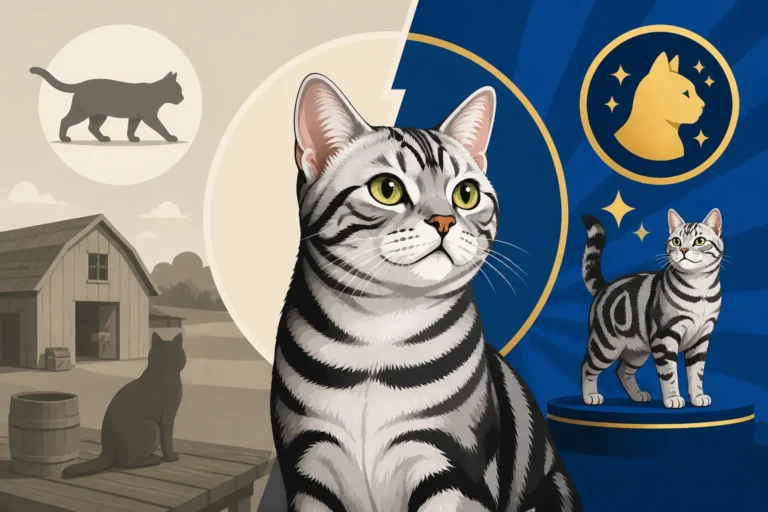
One major historical change was the breed’s name. Cats once shown under the broader name “Domestic Shorthair” were later distinguished as American Shorthairs. The rename helped separate a pedigreed breed with a defined type from the much larger population of shorthaired domestic cats. It did not mean that every physical feature was suddenly replaced or that the cats became a new breed overnight.
The distinction can be easy to miss because “domestic shorthair” is still commonly used to describe a mixed-ancestry shorthaired cat. A person may use that everyday description for a cat with a silver tabby coat and a stocky build, while a breeder uses “American Shorthair” to refer to a cat with documented lineage. The history behind the naming shift is explored in Why the American Shorthair Name Changed in 1966.
A name change can also make historical sources look inconsistent. Older material may describe the breed or its predecessors using terminology that is no longer used in the same way. When comparing old and new standards, check whether the text is describing the same registered breed under an earlier name, rather than assuming the difference proves the physical standard changed substantially.
The broad outline has remained recognizable
The American Shorthair has long been associated with a balanced, substantial working-cat build rather than an extreme silhouette. Its general outline is meant to look strong and capable, with features that fit together rather than drawing attention to one exaggerated trait. That broad idea remains central to how the breed is understood today.
The wording used to express that ideal can be refined, and show standards can add detail to explain proportions or distinguish acceptable variation from a fault. But a revision in wording does not necessarily point to a new body type. The difference between a written standard and the way a cat develops in real life is especially important for a breed whose adult build can take time to fill out.
For a closer look at the features judges assess, see What the American Shorthair Standard Asks For. That description is more useful than relying on a single photograph, which may emphasize coat color, pose, lighting, or camera angle rather than the overall shape and balance of the cat.
What changes and what stays stable
Wording, colors, and judging details can be revised
A standard can change in small but meaningful ways. A registry may clarify how to describe a feature, revise a show rule, or adjust how colors and patterns are grouped or accepted. The practical impact depends on the exact revision: some updates may mostly make a rule clearer, while others can affect whether a particular cat is eligible for a class or how a judge evaluates it.
That is why it is risky to hear “the standard changed” and assume every American Shorthair has changed with it. A change to a written description is not evidence that the breed’s whole population suddenly developed a different shape or temperament. Nor does a feature being less favored in the show ring mean a pet cat with that feature is unhealthy.
If you are reading an older description, compare it with the registry’s present standard rather than relying on summaries or forum posts. Look for the publication date, the registry name, and whether the text is a full standard or a short breed overview. For historical context, How the First American Shorthair Standard Read is a useful companion to How the American Shorthair Standard Reads Today.
Faults are not the same as health problems
Standards often distinguish between features that are preferred and features that count against a cat in competition. Some details may be treated as faults, while other conditions may affect eligibility. The exact language depends on the registry and its current document. A show fault is a judging category; it is not automatically a medical diagnosis.
This distinction matters for anyone considering a pet. A cat that does not meet every show preference can still be affectionate, active, and healthy. Conversely, a cat that looks close to the standard is not guaranteed to be free of health issues. Appearance and health are related in some contexts, but they are not interchangeable measures.
If you are trying to interpret a particular feature, first check how the registry defines it. Then ask whether the concern is about show placement, breed identification, or the cat’s wellbeing. These are different questions. Which Faults Judges Mark on an American Shorthair can help explain the show context without treating every departure from the ideal as a problem.
| What may change in a standard | What that change usually means | What it does not automatically mean |
|---|---|---|
| Wording or definitions | The registry is clarifying how a feature is described | The breed has been physically reinvented |
| Color or pattern rules | Show eligibility or classification may be affected | A cat outside a show category is unhealthy |
| Judging guidance | Judges may receive clearer criteria for comparison | Every judge will interpret every detail identically |
| Registry procedures | Rules may differ between organizations | There is one rulebook binding all registries |
How to use the standard as an owner or future buyer
Check the registry and the version
If a breeder, show catalog, or online post quotes a standard, identify which organization it comes from. Then look for the full document and its revision information. A short breed profile may simplify details for general readers, while a show standard is written for a more technical purpose. Comparing those two kinds of material can create the impression of disagreement even when they are serving different audiences.
If you are buying a kitten, the standard can help you understand the breed’s intended type, but it should not replace practical questions about the kitten’s background and care. Ask what registration and pedigree documentation is available, what health checks have been done, and how the breeder describes the kitten’s temperament. A tidy coat pattern or convincing face is not proof of ancestry by itself.
For broader context on how breed identity is documented, see Whether Papers Are the Only Proof an American Shorthair Has. The standard tells you what a registry seeks in an ideal example; pedigree records establish a cat’s recorded family history. Those are related, but they answer different questions.
Use the standard as context, not a shopping checklist
It is tempting to compare a pet cat against a list of show features and decide that something is “wrong” because the cat looks different from a champion in a photograph. In practice, coat development, age, sex, body condition, posture, and individual variation can all affect appearance. A young cat may not yet have the mature build people associate with the breed, and a photograph can make a head or body look more or less substantial than it is.
For everyday care, focus on the individual cat. If you are choosing a brush because the coat is shedding, a practical grooming tool matters more than whether the coat matches a show description; Chewy is one retailer where owners may compare basic grooming supplies. If a carrier is the sticking point before a vet visit, checking dimensions and construction at Chewy can be more useful than judging the cat against a breed illustration.
Likewise, a standard cannot tell you how much food your cat needs or whether a change in weight is healthy. Use your veterinarian’s guidance for those decisions. If you are gathering everyday supplies, Chewy may be one option for comparing routine items, but the standard itself is not a shopping list or a substitute for individual veterinary advice.
The short answer is that the American Shorthair standard has been refined over time, as breed standards and registry rules can be. The breed’s name and show language have changed, and particular details may be clarified or adjusted. But those changes should not be mistaken for a wholesale transformation of the breed. To interpret any specific claim, identify the registry, compare the relevant standard versions, and separate show preferences from questions about a cat’s identity or health.
Disclaimer
This article is for general informational purposes only and does not constitute professional advice. Laws, prices and regulations vary by location and change over time. Consult a qualified professional for guidance on your specific situation.