Whether a Cobby American Shorthair Is Penalized
A compact, muscular American Shorthair can look “cobby” without being out of standard, so the word alone does not decide how a cat will do in the show ring. What matters is the whole outline: body length, leg proportion, balance, and condition. This guide explains what judges are looking for, when a stocky build may count against a cat, and how to tell sturdy breed type from excess weight.
What judges mean by a cobby American Shorthair
Cobby describes an impression, not a single measurable fault
People often use cobby to mean short, broad, compact, and solid. That can be a convenient description at home, but it is not enough to predict a show result. A judge assesses the cat against the applicable breed standard and considers how its features work together—not simply whether it feels heavy or looks broad when curled up on a sofa.
The American Shorthair is meant to look strong and substantial. It has a broad chest, a muscular body, and a sturdy frame, so a well-built cat may look stocky beside a long, fine-boned breed. That does not automatically make it excessively compact. For a clearer picture of the intended type, see What the American Shorthair Standard Asks For and Why an American Shorthair Is Built Square.
In practical terms, a judge is looking at proportions as the cat stands and moves. Does the body have the balance and length expected for the breed? Do the legs support the frame appropriately? Does the cat look powerful and well-muscled, or unusually low and compressed? The word “cobby” might describe what someone notices, but the judge’s evaluation rests on those underlying features.
The American Shorthair is sturdy, but not meant to look compressed
A broad chest and strong musculature are not problems to be corrected. They are part of the American Shorthair’s sturdy appearance. The distinction is between a cat that is powerfully built and one whose body looks markedly short and compact in proportion to its height. The breed’s outline should still look balanced rather than compressed.
That balance is easy to misread in photographs. A cat sitting with its paws tucked under it may look very short through the body; a low camera angle can make the legs seem shorter, too. A standing side view is more useful for judging overall proportions, while a front view can help show chest width and the relationship between the shoulders and body.
The breed’s medium-length legs contribute to that overall outline. They should look in proportion to a sturdy body, not so short that the cat appears unusually close to the floor. For more on how leg proportion contributes to breed type, see Why an American Shorthair's Legs Are Medium Length.
When a stocky build may count against a cat
Excessive compactness can conflict with the intended outline
A genuinely very short, low-set body may look different from the balanced, substantial build expected in an American Shorthair. If the cat seems compressed from shoulder to hip, or the legs appear disproportionately short for its frame, a judge may consider that when evaluating its conformation. The concern is not that the cat is strong or broad; it is whether those features come at the expense of proportion.
There is no useful rule such as “a cobby American Shorthair loses a fixed number of points.” Show judgments are made according to the relevant registry’s standard and the individual cat in front of the judge. The label cobby is not, by itself, a universal automatic disqualification. Instead, a pronounced departure from the desired type may affect how the cat compares with other entries.
It is also worth separating a short-looking body from other features that can create the same impression. A cat with a broad chest, a rounded stance, or a heavy coat may look more compact than it is. A judge can assess its structure in person, where posture, movement, and the relationship between body parts are easier to see than in a single photograph.
Weight can make a correct frame look too compact
Extra body fat can blur the outline and make a cat appear shorter, rounder, or lower to the ground. That is different from having a naturally sturdy frame. A muscular American Shorthair may be solid to the touch, but a heavy layer of fat can hide the waist and make the abdomen look fuller. A show assessment considers the cat’s condition as well as its underlying structure.
At home, do not try to judge body condition from the scale alone. Two cats with the same weight may have different frames, and a large-framed cat may naturally weigh more than a smaller one. A vet can help assess whether the cat is at a healthy condition for its frame. If you keep a weight log, a pet scale or other basic weighing supplies are easy to find through local pet shops or retailers such as Chewy; the number is most useful when interpreted alongside body shape and veterinary guidance.
A cat that has gained weight should not be put on a crash diet for the sake of a show silhouette. Sudden or severe food restriction can be dangerous, and weight management should be planned with a veterinarian. For a fuller discussion of normal breed size and frame, see How Big an American Shorthair Gets and What an American Shorthair Weighs.
| What you notice | What it may mean | What to look at next |
|---|---|---|
| Broad chest and firm muscles | Often consistent with the breed’s sturdy build | Check the cat’s full proportions rather than chest width alone |
| Short-looking body in a seated photo | May be posture or camera angle | Compare with a standing side view |
| Very low stance or notably short-looking legs | Could affect the overall balance | Consider leg-to-body proportion in person |
| Round outline with little visible waist | Could reflect excess weight, coat, or frame | Ask a vet to assess body condition |
| Strong, compact appearance with balanced proportions | May simply be a substantial American Shorthair | Compare the whole outline with the breed standard |
How to tell sturdy breed type from excess weight
Look at body condition as well as the silhouette
A cat’s broad frame can make it look heavier than it is, so visual impressions deserve a second look. When the cat is standing naturally, notice whether the torso has some narrowing behind the ribs and whether the abdomen has a modest upward tuck toward the hind legs. Those clues are more helpful than deciding from a front-facing photo that the cat “looks round.”
Gentle hands-on checks can help, too. You should generally be able to feel the ribs under a light covering without pressing hard. If the ribs are difficult to find, or the waist is hard to see from above, ask your veterinarian to assess the cat’s body condition. Do not assume that a muscular cat is overweight—or that a cat is lean just because it has a short coat.
For consistency, weigh the cat under similar conditions and keep a simple record. A scale can be useful if the cat will stand on it calmly; otherwise, a clinic can help with weighing. Chewy is one place owners may look for a home pet scale, but whichever option you choose, use the readings as a tracking tool rather than a substitute for a veterinary assessment.
Consider head, legs, movement, and body together
No single feature determines whether a cat looks correct for the breed. A very broad head might make the overall impression seem more compact, while the stance can change how long the body appears. The judge considers the whole animal, including its head shape, body, legs, and movement. What Shape an American Shorthair's Head Should Be offers more detail on one part of that picture.
Movement can provide useful context for owners, though it is not a do-it-yourself show score. Watch whether the cat moves comfortably and evenly rather than judging its structure from the way it sits or lounges. If a cat is suddenly reluctant to jump, has a new limp, or seems stiff, treat that as a possible health concern—not as a breed-type issue to be fixed through exercise or dieting.
A well-proportioned American Shorthair should read as strong and balanced, not delicate. But “solid” does not mean every cat should be equally broad or equally heavy. Natural variation exists, and the purpose of the standard is to describe the breed’s overall type, not to make every individual look identical.
What owners can do before a show
Ask for an assessment based on the relevant standard
If you are considering showing your cat, ask an experienced breeder, club member, or show judge to assess the cat in person. Photos can help start a conversation, but they cannot reliably show how a cat stands, moves, or feels. It is also important to confirm which registry’s rules apply, since show procedures and standards may differ.
Ask specific questions rather than only, “Is my cat too cobby?” For example: Is the body proportionate to the legs? Does the cat have the expected sturdy outline? Is the apparent compactness caused by posture, coat, or body condition? A more precise discussion gives you useful feedback and avoids turning a broad descriptive word into a verdict.
The show ring is comparative. A cat can meet the general idea of the breed and still be placed behind another cat whose overall type is judged stronger on that day. That does not necessarily mean the first cat has a serious fault, and a placement is not a complete assessment of health or suitability as a companion. How a Show American Shorthair Is Handled in the Ring explains more about what happens during evaluation.
Keep preparation focused on comfort and condition
Good preparation means keeping the cat healthy, comfortable, and accustomed to handling. Regular gentle practice with being examined can make a show setting less stressful. Keep grooming simple and appropriate for the coat; avoid trying to alter the cat’s outline with products or by changing its weight quickly. If you need grooming basics, a comb or brush from a local shop or a retailer such as Chewy can be part of an ordinary care kit, but no grooming tool can change the cat’s underlying proportions.
If your cat is a pet rather than a show prospect, there is no reason to worry that a sturdy build makes it less of an American Shorthair. A show standard describes a desired type; it is not a measure of how much a cat is loved, how healthy it is, or whether it belongs in a home. Some pet cats can be shown, depending on registry rules and the individual cat’s eligibility. See Whether a Pet American Shorthair Can Be Shown for more on that question.
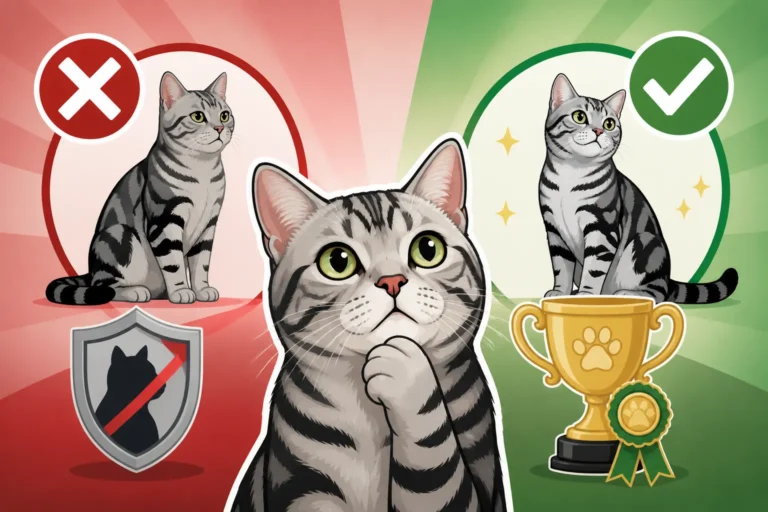
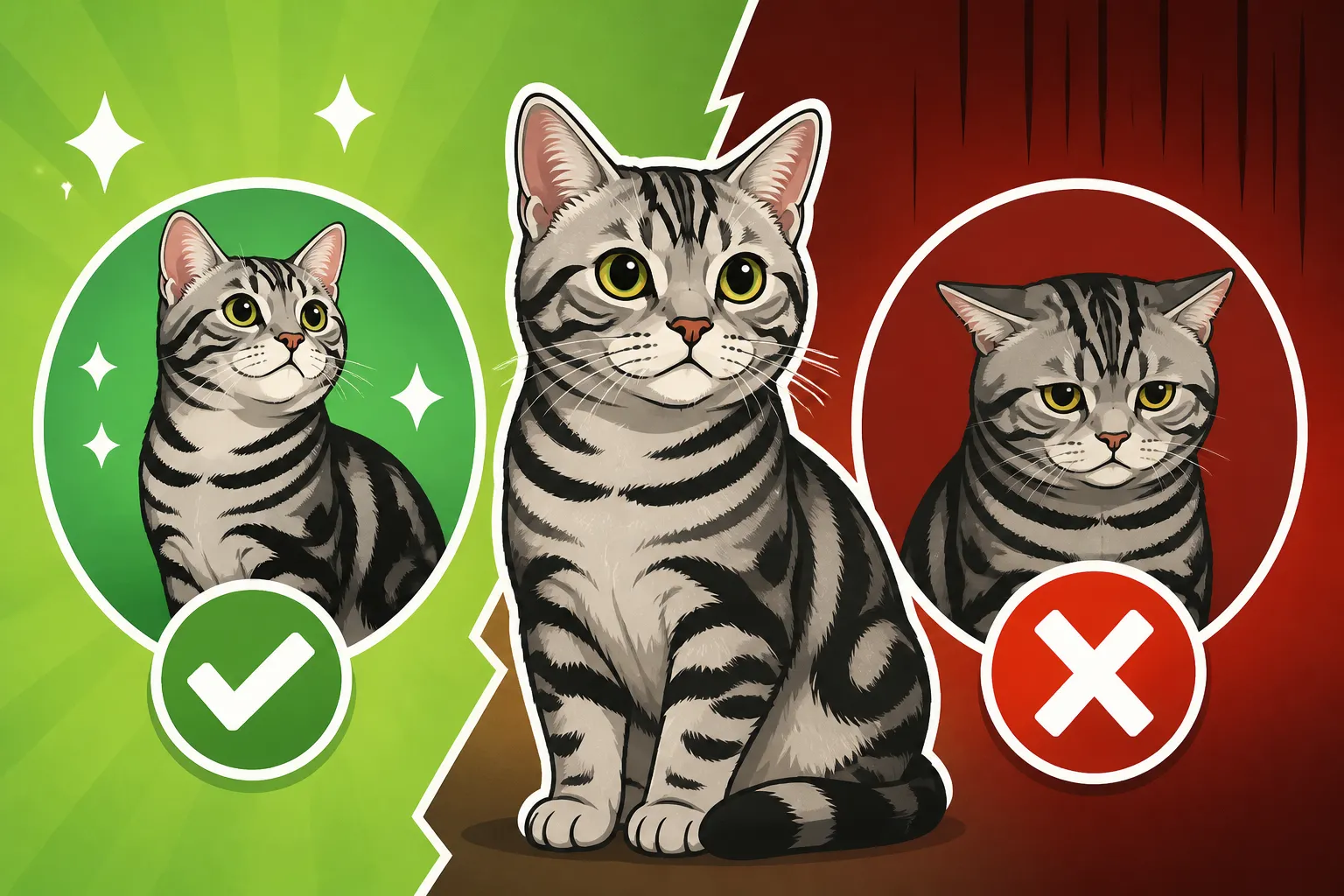
The practical answer is that an American Shorthair is not automatically penalized just because someone calls it cobby. A powerful, broad, muscular cat can be exactly the kind of sturdy cat people expect this breed to be. Concern arises when the overall shape looks excessively short, low, or out of balance—or when excess weight obscures the cat’s natural outline. The judge evaluates the whole cat against the applicable standard, not one adjective.
Disclaimer
This article is for general informational purposes only and does not constitute professional advice. Laws, prices and regulations vary by location and change over time. Consult a qualified professional for guidance on your specific situation.